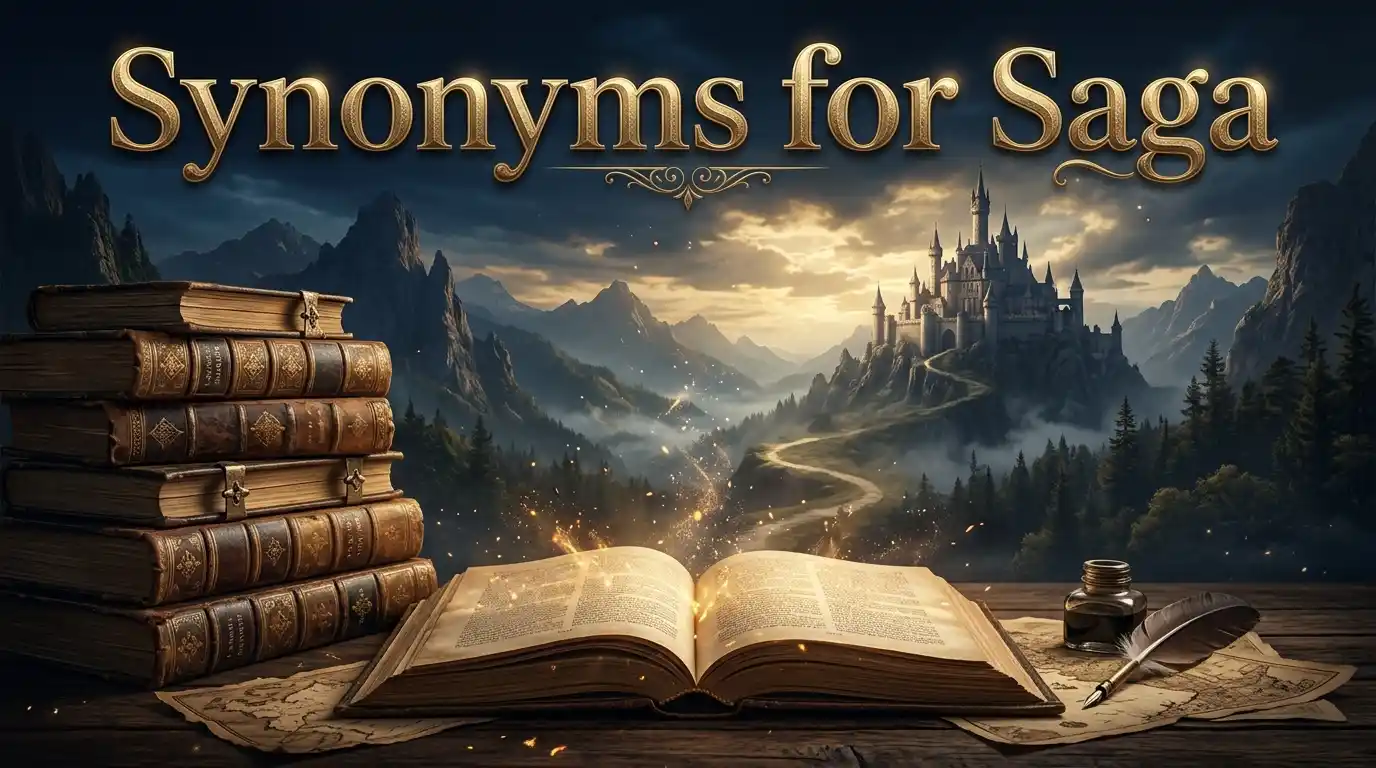
A quiet, open antique book beside a winding path leading toward a distant castle, suggesting a long, dramatic story filled with history and adventure. Clean, minimal landscape composition with warm, natural colors and no text.
The best synonyms for saga include story, tale, narrative, epic, chronicle, legend, account, and odyssey. Each word has a slightly different meaning. Epic emphasizes an impressive or lengthy story, chronicle focuses on events recorded over time, and odyssey suggests a long, eventful journey. The right choice depends on whether you mean a dramatic story, a family history, or a prolonged series of events.
Sometimes, a simple story becomes so complicated that it feels like a saga. A family’s history may stretch across generations, a fictional adventure may follow heroes through countless challenges, or a disagreement may continue for months.
Choosing the right alternative helps you express the exact idea. Calling a book an epic highlights its scale, while calling a long journey an odyssey emphasizes the challenges along the way.
This guide explores synonyms for saga, explains their shades of meaning, and helps students, bloggers, content writers, and everyday English users choose words that fit their context.
What Does “Saga” Really Mean?
A saga is a long, detailed story, often involving several events, generations, or adventures. Traditionally, the word describes lengthy narratives about families, heroes, or historical figures. In everyday English, it can also describe a complicated series of real-life events that continues over a long period.
For example, a novel about several generations of one family may be called a family saga. A lengthy dispute over an inheritance might be described as a legal saga. The word can suggest something dramatic, complicated, or unusually drawn out.
Saga is a noun. Depending on the context, it can sound grand and adventurous, historically significant, or slightly humorous when used for an everyday problem that seems never-ending.
Connotative Meaning of Saga
Connotation refers to the feelings or associations a word carries beyond its basic definition.
- Positive: A saga may suggest courage, adventure, family legacy, or an extraordinary achievement.
- Neutral: It can simply describe a long narrative or a detailed account of events.
- Negative or humorous: When applied to an ongoing problem, it may suggest frustration, unnecessary complications, or a situation that has dragged on too long.
For example, an inspiring family saga sounds meaningful and emotional, while the saga of the missing paperwork may suggest that a routine task has become unnecessarily complicated.
Etymology and Pronunciation
The word saga comes from Old Norse, where it referred to a story, tale, or account. It became associated with traditional narratives about Scandinavian families, rulers, and heroes.
- US pronunciation: /ˈsɑːɡə/
- UK pronunciation: /ˈsɑːɡə/
- Syllables: sa-ga (2 syllables)
Synonyms for Saga: Grouped by Shade of Meaning
Not every related word is a perfect replacement for saga. The closest alternatives describe a long story or account, while others fit only specific contexts, such as a historical record, a heroic adventure, or a prolonged real-life problem.
1. Direct Alternatives for a Long Story
Use these words when you mean an extended narrative, whether fictional or based on real events.
- Story — an account of connected events.
- Tale — a story, often entertaining or imaginative.
- Narrative — a structured account of events.
- Epic — a grand story involving heroic deeds.
- Chronicle — a detailed record of events over time.
- Account — a description of what happened.
- History — a record of past events.
- Yarn — an informal, often entertaining story.
Story and tale are versatile choices. Epic and chronicle are more specific, so they work best when the story’s scale or historical sequence matters.
2. Alternatives for Legendary or Heroic Stories
These terms fit sagas involving heroes, ancient traditions, extraordinary adventures, or events passed down through generations.
- Legend — a traditional story associated with a person or place.
- Myth — a traditional story explaining beliefs or origins.
- Heroic tale — a story centered on courageous deeds.
- Epic narrative — an expansive story of major events.
- Romance — a narrative involving adventure or idealized heroism.
- Adventure story — a tale of exciting experiences and challenges.
These alternatives are not interchangeable in every situation. A myth often has cultural or religious significance, while a legend may be associated with a historical figure whose story has changed over time. An epic generally emphasizes scale, heroism, or extraordinary events.
3. Alternatives for a Long Series of Events
When saga describes a journey, an extended struggle, or a complicated chain of developments, these words may communicate the idea more precisely.
- Odyssey — a long journey full of challenges.
- Journey — a process involving change or progress.
- Adventure — an experience involving excitement or uncertainty.
- Sequence — a series of events in a particular order.
- Series — a number of connected events or installments.
- Episode — one event within a larger sequence.
- Ordeal — a difficult or painful experience.
- Misadventure — an unfortunate or troublesome experience.
An odyssey is especially useful when the journey itself is central to the story. An ordeal emphasizes hardship rather than storytelling, while series highlights connected events without necessarily suggesting drama.
4. Alternatives for Family History and Generations
A saga often follows a family over many years. In this context, the following terms can be more specific.
- Family history — an account of a family’s past.
- Family narrative — a story about a family’s experiences.
- Generational story — a narrative spanning multiple generations.
- Dynastic history — the history of a ruling or influential family.
- Genealogy — the study of family relationships and ancestry.
- Ancestral history — an account of earlier family generations.
These expressions have different uses. Family saga usually implies an extended, eventful narrative, while genealogy focuses on family relationships and descent. Dynastic history is most appropriate when discussing a ruling family or an influential lineage.
5. Alternatives for a Detailed Record of Events
When a saga focuses on what happened and how events unfolded, these terms may be useful.
- Record — documented information about events.
- Documentation — materials that provide evidence or details.
- Retelling — a new telling of an existing story.
- Recounting — the act of describing past events.
- Testimony — a statement about something witnessed or experienced.
- Memoir — a personal account of selected life experiences.
These are related alternatives rather than exact synonyms. A memoir focuses on personal experiences, while testimony often has a formal or legal meaning. Use chronicle when the events are recorded over time.
Example Sentences Using Saga Synonyms
- The epic follows a young warrior who must protect his homeland from invading forces.
- Her grandmother shared a fascinating tale about the family’s early years.
- The historian published a detailed chronicle of the kingdom’s rise and fall.
- Their journey across the mountains became an odyssey filled with unexpected challenges.
- The family history revealed how three generations had built the business.
Synonyms for Saga by Tone
Tone matters because a word can make a story sound grand, factual, informal, or frustrating.
| Tone | Suitable alternatives | Best use |
|---|---|---|
| Formal | Narrative, chronicle, account, historical record | Academic and professional writing |
| Neutral | Story, tale, history, series | Everyday conversation and general writing |
| Grand or literary | Epic, legend, odyssey, heroic tale | Fiction, reviews, and dramatic storytelling |
| Casual | Yarn, adventure, long-running story | Informal conversations |
| Negative or critical | Ordeal, misadventure, drawn-out affair | Describing a troublesome experience |
Not every word in the table is a direct synonym. For instance, ordeal describes hardship, while chronicle emphasizes a record of events. Choose based on the meaning you intend, not tone alone.
Saga vs. Close Alternatives
Saga vs. Epic
Both words can describe long, impressive stories. However, epic usually emphasizes grand scale, heroic actions, or extraordinary events, while saga often emphasizes a long sequence of connected events or a story spanning generations.
Use epic for a sweeping heroic adventure. Choose saga for a family’s long history or a complicated series of developments.
Saga vs. Chronicle
A saga is generally a long, eventful narrative. A chronicle is a record of events, often arranged in chronological order.
For example, a novel following a family through several generations might be a family saga. A historical document recording the major events of those generations would be a chronicle.
Saga vs. Odyssey
An odyssey specifically suggests a long journey, often one filled with difficulties and discoveries. A saga may describe a journey, but it can also focus on family history, heroic narratives, or an extended real-life situation.
Use odyssey when the journey is the main point. Use saga when the broader story or continuing sequence of events matters more.
How Saga Synonyms Change by Context
Daily Conversation
In everyday speech, story, tale, and long-running problem often sound more natural than chronicle or epic.
For example, you might say, “The story of how they met is fascinating.” If you’re talking about an unresolved practical issue, “This whole situation has turned into a saga” sounds conversational and slightly humorous.
Writing and Blogging
Writers can use narrative, chronicle, or family saga to give readers a clearer idea of the subject.
A blog post about an organization’s past might use history. A review of a multi-generational novel might use family saga. The best choice tells readers what kind of story they can expect.
Related reading: [internal link: synonyms for story → synonyms-for-story]
Professional or Academic Writing
In formal writing, account, narrative, chronicle, and historical record can be more precise than saga.
For example, a research paper may refer to a historical account rather than a historical saga if the goal is objective description. Use saga when the extended or dramatic nature of the events is relevant.
Creative or Informal Writing
In fiction, epic, legend, odyssey, and heroic tale help establish different expectations.
An epic suggests scale and significance. A legend evokes tradition or extraordinary deeds. An odyssey highlights a challenging journey. For a humorous account of a never-ending everyday problem, saga itself may be the most expressive choice.
Related reading: [internal link: synonyms for adventure → synonyms-for-adventure]
Common Mistakes Learners Make
1. Treating Every Long Story as an Epic
An epic usually carries a sense of grandeur or heroic scale. A long personal anecdote is not necessarily an epic.
Better choice: Use story or narrative for a general account and epic for a grand or heroic one.
2. Using Chronicle When You Mean Adventure
A chronicle records events; it does not automatically suggest excitement or danger.
Better choice: Use adventure or odyssey when the challenges and experiences are the main focus.
3. Confusing a Myth With a Historical Account
A myth is a traditional narrative often connected with cultural beliefs, origins, or supernatural figures. It is not simply another word for any historical story.
Better choice: Use history or historical account for documented past events.
4. Using Saga for Every Long Problem
Although saga can describe an ongoing problem, using it for every inconvenience can sound exaggerated.
Better choice: Use issue, dispute, or ordeal when one of these more specific words captures the situation.
5. Choosing a Formal Word for Casual Conversation
Words such as chronicle and historical narrative can sound unnecessarily formal in everyday speech.
Better choice: Use story or tale unless the context calls for a more specialized term.
FAQs About Synonyms for Saga
What is the closest synonym for saga?
Story is one of the closest general synonyms for saga. Depending on the context, tale, narrative, epic, or chronicle may be more precise.
What is a formal synonym for saga?
Narrative, chronicle, and account are useful formal alternatives. Choose chronicle for a record of events over time and narrative for a structured account of connected events.
What is a casual synonym for saga?
Story and tale are natural casual alternatives. In conversation, long-running story or whole situation may work when describing an ongoing real-life problem.
What is a synonym for a family saga?
Family history, family narrative, and generational story can work, depending on the meaning. Family saga is especially suitable when the story follows connected events and relationships across several generations.
What is the opposite of saga?
There is no exact opposite of saga. Depending on the context, brief account, short story, or isolated incident may contrast with a long, extended narrative.
Conclusion
Learning alternatives to saga helps you describe stories, family histories, heroic adventures, and complicated situations more precisely. Words such as story, epic, chronicle, and odyssey overlap in meaning, but each emphasizes something different.
When choosing a replacement, consider what matters most: the length of the story, its historical importance, its dramatic quality, or the challenges involved. That small distinction can make your writing clearer and more natural.
To strengthen your vocabulary, try using these words in your next essay, blog post, email, or everyday conversation. You can also explore the synonyms for saga to discover additional alternatives and compare their meanings.

Daniel Mercer writes about measurements, dimensions, unit conversions, and the practical meaning of numbers in everyday life. His articles focus on explaining small and large measurements in clear language, using accurate conversions and useful comparisons to help readers develop an intuitive understanding of size and scale.