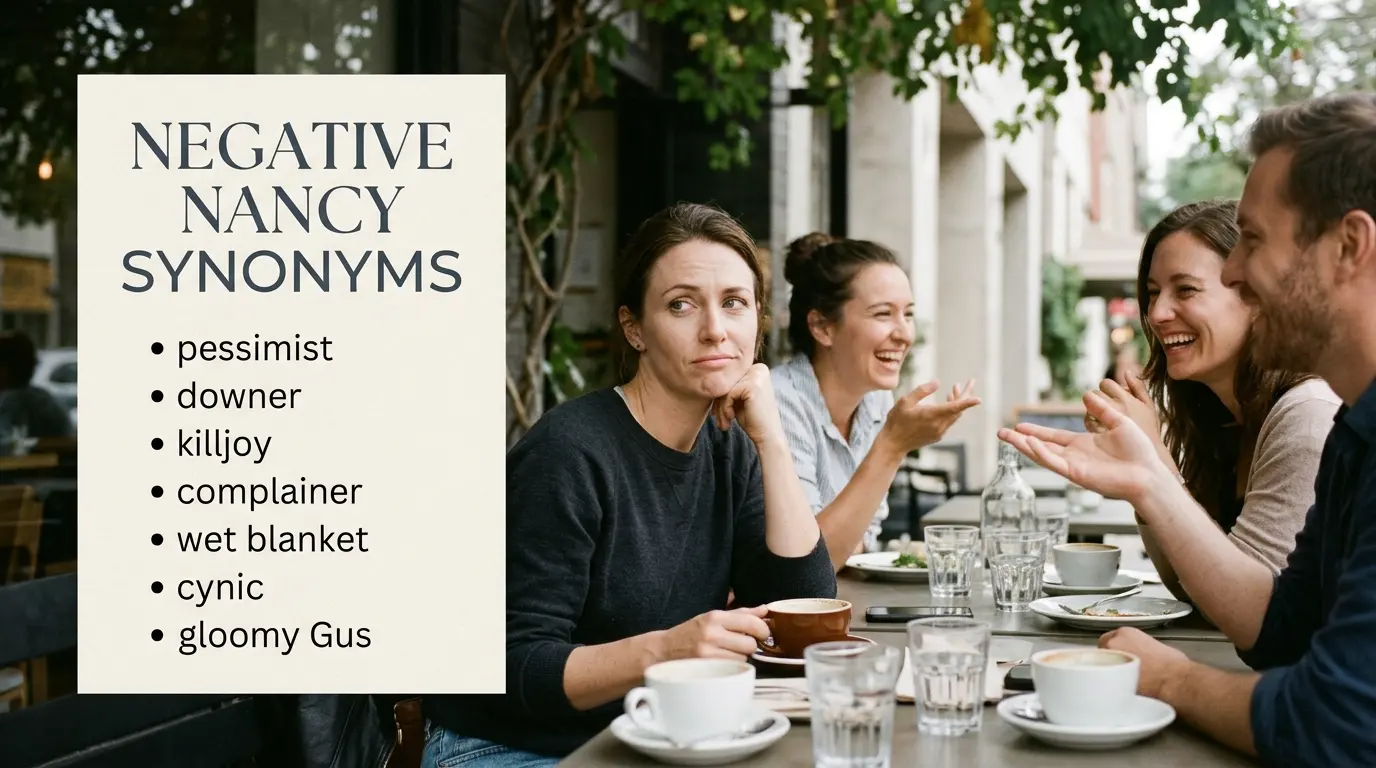
Negative Nancy synonyms help you describe someone who regularly focuses on problems, expects bad outcomes, or finds something wrong with almost every situation. Imagine sharing exciting news, only to hear why it will fail.
A friend might respond to every new idea with complaints or warnings. You could call that person a pessimist, a complainer, or a “Debbie Downer,” depending on the behavior and tone.
Learning negative nancy synonyms gives students, bloggers, content writers, and everyday English users more ways to describe negative attitudes. Some alternatives sound playful, while others express stronger criticism.
This guide explains useful alternatives, their pronunciations, and real-life examples. You will also learn which words fit casual conversations, professional writing, and situations where a person’s negativity affects others.
What Does “Negative Nancy” Really Mean?
Negative Nancy is an informal expression for someone who habitually focuses on the negative side of situations. This person may complain frequently, expect things to go wrong, or dismiss ideas before considering their benefits.
The phrase is often used humorously or critically. For example, if someone responds to every vacation suggestion by listing everything that could go wrong, a friend might say, “Don’t be such a Negative Nancy!”
The expression is generally understandable in American English and is used in casual conversations, social media, workplace banter, and popular culture. It is not usually suitable for formal academic writing.
Part of Speech
Negative Nancy is a noun phrase. It labels a person whose attitude or comments are consistently negative.
- Example: “Mark is being a Negative Nancy about our plans.”
- Related adjective: Negative.
- Related noun: Negativity.
The expression describes a person’s behavior or perceived attitude. It should not automatically be treated as a complete description of someone’s personality.
Connotative Meaning
(Connotation means the feelings or associations a word or phrase carries beyond its basic meaning.)
- Positive tone: The phrase itself is rarely positive, but a lighthearted use among friends may encourage someone to look at a situation differently.
- Negative tone: It can suggest constant complaining, pessimism, criticism, or a lack of enthusiasm.
- Neutral tone: In an objective discussion, expressions such as pessimistic attitude or habitual negativity are often more neutral and precise.
Context matters. Calling a friend a Negative Nancy with a smile may be playful. Using the same label to dismiss a colleague’s legitimate safety concerns may be unfair.
Etymology of Negative Nancy
The expression combines negative with the familiar personal name Nancy. The name gives the phrase a conversational, person-like quality.
Negative entered English through French and Latin, ultimately connected with Latin negare, meaning “to deny.” The name Nancy developed as a familiar form of Anne.
The exact origin of Negative Nancy is not firmly established. It belongs to a broader pattern of informal expressions that use a person’s name to describe a recognizable behavior.
Old English (450–1100)
The modern expression Negative Nancy did not exist in Old English. However, English already had words and expressions for denial, disagreement, and unfavorable judgments.
The expression’s components have different histories, and the phrase itself should not be projected back into this period.
Middle English (1100–1500)
During the Middle English period, English absorbed many words from French and Latin. The linguistic history of negative is connected to this wider development of vocabulary for denial and opposition.
The modern phrase, however, emerged much later as part of informal English.
Modern English (1500–Present)
In Modern English, negative developed into a common word for unfavorable attitudes, results, or judgments. The expression Negative Nancy became part of casual speech as a memorable way to describe someone who repeatedly expects the worst or focuses on drawbacks.
Today, it is often used humorously, though it can also sound dismissive.
Pronunciation, Syllables, and Word Structure
- US pronunciation: Negative Nancy — /ˈnɛɡətɪv ˈnænsi/
- UK pronunciation: Negative Nancy — /ˈneɡətɪv ˈnænsi/
- Syllables: neg-a-tive nan-cy
- Part of speech: Noun phrase
- Main word: Negative
- Prefix: Neg- is part of the historical word structure; it is not a productive prefix in this phrase.
- Suffix: -ive in negative
- Name element: Nancy
The phrase is normally capitalized as Negative Nancy when used as a nickname-like label. In the middle of a sentence, capitalization may vary by editorial style, but capitalizing both words makes the expression recognizable.
40 Negative Nancy Synonyms: Meanings and Examples
Not every alternative has exactly the same meaning as Negative Nancy. Some describe pessimism, others describe complaining, and some refer to a person who discourages others.
Choose the word that matches the behavior you want to describe.
1. Pessimist
US: /ˈpesɪmɪst/ | UK: /ˈpesɪmɪst/
Meaning: A person who usually expects unfavorable outcomes.
Examples:
- Don’t be a pessimist; we still have time to solve the problem.
- As a pessimist, Liam expected the event to go badly.
2. Complainer
US: /kəmˈpleɪnər/ | UK: /kəmˈpleɪnə/
Meaning: A person who frequently expresses dissatisfaction or makes complaints.
Examples:
- The constant complainer found fault with every restaurant.
- Nobody wanted to sit beside a complainer during the trip.
3. Debbie Downer
US: /ˈdebi ˈdaʊnər/ | UK: /ˈdebi ˈdaʊnə/
Meaning: An informal expression for someone who brings a gloomy or negative mood to a situation.
Examples:
- Don’t be a Debbie Downer when everyone is celebrating.
- He turned into a Debbie Downer as soon as we discussed the party.
4. Downer
US: /ˈdaʊnər/ | UK: /ˈdaʊnə/
Meaning: An informal term for someone or something that makes people feel less cheerful.
Examples:
- Stop being such a downer and enjoy the evening.
- His gloomy comments were a real downer at dinner.
5. Defeatist
US: /dɪˈfiːtɪst/ | UK: /dɪˈfiːtɪst/
Meaning: A person who assumes failure is inevitable and gives up too easily.
Examples:
- A defeatist attitude will not help us finish the project.
- She sounded defeatist before the competition even began.
6. Cynic
US: /ˈsɪnɪk/ | UK: /ˈsɪnɪk/
Meaning: A person who tends to doubt people’s motives or believe that others act mainly out of self-interest.
Examples:
- The cynic assumed the charity event was only for publicity.
- Even a cynic could appreciate the team’s honest efforts.
7. Naysayer
US: /ˈneɪˌseɪər/ | UK: /ˈneɪˌseɪə/
Meaning: A person who regularly opposes ideas or predicts that plans will fail.
Examples:
- The naysayer dismissed the proposal without reading it.
- Every new business idea seemed to attract a naysayer.
8. Gloomy Person
US: /ˈɡluːmi ˈpɜːrsən/ | UK: /ˈɡluːmi ˈpɜːsən/
Meaning: Someone who often seems sad, pessimistic, or without hope.
Examples:
- The gloomy person expected the picnic to be a disaster.
- He sounded like a gloomy person whenever the weather changed.
9. Killjoy
US: /ˈkɪlˌdʒɔɪ/ | UK: /ˈkɪlˌdʒɔɪ/
Meaning: Someone who spoils other people’s enjoyment or enthusiasm.
Examples:
- Don’t be a killjoy; join us for the game.
- His complaints about the music made him sound like a killjoy.
10. Wet Blanket
US: /ˌwet ˈblæŋkɪt/ | UK: /ˌwet ˈblæŋkɪt/
Meaning: An informal expression for someone who discourages excitement or spoils the mood.
Examples:
- She acted like a wet blanket when we suggested a weekend trip.
- Don’t be a wet blanket about the birthday surprise.
11. Grumbler
US: /ˈɡrʌmblər/ | UK: /ˈɡrʌmblə/
Meaning: Someone who complains in a low, dissatisfied, or persistent way.
Examples:
- The grumbler complained about the long queue.
- My grandfather can be a grumbler before his morning coffee.
12. Moaner
US: /ˈmoʊnər/ | UK: /ˈməʊnə/
Meaning: An informal term for someone who frequently complains or expresses dissatisfaction.
Examples:
- He’s a moaner who finds something wrong with every plan.
- The moaner complained even after the team won.
13. Whiner
US: /ˈwaɪnər/ | UK: /ˈwaɪnə/
Meaning: Someone who complains in an annoying, often childish or self-pitying way.
Examples:
- Stop being a whiner and tell us what you need.
- The whiner kept complaining about having to walk.
14. Faultfinder
US: /ˈfɔːltˌfaɪndər/ | UK: /ˈfɔːltˌfaɪndə/
Meaning: A person who constantly looks for mistakes or shortcomings.
Examples:
- The faultfinder criticized every detail of the presentation.
- A faultfinder may overlook the effort behind good work.
15. Nitpicker
US: /ˈnɪtˌpɪkər/ | UK: /ˈnɪtˌpɪkə/
Meaning: Someone who focuses excessively on tiny mistakes or unimportant details.
Examples:
- The nitpicker complained about a barely noticeable typo.
- Don’t be a nitpicker when the main idea is already clear.
16. Critic
US: /ˈkrɪtɪk/ | UK: /ˈkrɪtɪk/
Meaning: A person who evaluates or judges something, sometimes by emphasizing its weaknesses.
Examples:
- The critic focused on everything the team did wrong.
- A fair critic recognizes strengths as well as weaknesses.
Usage note: Criticism is not automatically negative. A critic can offer thoughtful and useful feedback.
17. Complainer-in-Chief
US: /kəmˌpleɪnər ɪn ˈtʃiːf/ | UK: /kəmˌpleɪnə ɪn ˈtʃiːf/
Meaning: A humorous expression for the person who complains more than everyone else.
Examples:
- My brother became the complainer-in-chief during our road trip.
- The office’s complainer-in-chief objected to the new coffee machine.
18. Sourpuss
US: /ˈsaʊrˌpʊs/ | UK: /ˈsaʊəˌpʊs/
Meaning: An informal term for someone who often looks unhappy or behaves in a disagreeable way.
Examples:
- Cheer up, sourpuss; it’s a beautiful day.
- He looked like a sourpuss throughout the family gathering.
19. Grouch
US: /ɡraʊtʃ/ | UK: /ɡraʊtʃ/
Meaning: A person who is frequently irritable, grumpy, or complaining.
Examples:
- The old grouch complained about the noisy children.
- I become a grouch when I don’t get enough sleep.
20. Grump
US: /ɡrʌmp/ | UK: /ɡrʌmp/
Meaning: An informal word for a person who is often bad-tempered or easily annoyed.
Examples:
- Don’t mind Sam; he’s a grump before lunchtime.
- The grump objected to every suggestion we made.
21. Pessimistic Person
US: /ˌpesɪˈmɪstɪk ˈpɜːrsən/ | UK: /ˌpesɪˈmɪstɪk ˈpɜːsən/
Meaning: Someone who generally expects bad results rather than good ones.
Examples:
- A pessimistic person may assume the interview went badly.
- Even a pessimistic person can learn to consider positive possibilities.
22. Negative Thinker
US: /ˈneɡətɪv ˈθɪŋkər/ | UK: /ˈneɡətɪv ˈθɪŋkə/
Meaning: Someone who tends to focus on problems, risks, or unfavorable possibilities.
Examples:
- As a negative thinker, he struggled to see the benefits of change.
- A negative thinker may need more evidence before trusting a new plan.
23. Doom-and-Gloomer
US: /ˌduːm ən ˈɡluːmər/ | UK: /ˌduːm ən ˈɡluːmə/
Meaning: An informal expression for someone who constantly predicts disaster or talks about terrible outcomes.
Examples:
- The doom-and-gloomer predicted that the whole event would fail.
- We needed a practical plan, not another speech from the doom-and-gloomer.
24. Doomsayer
US: /ˈduːmˌseɪər/ | UK: /ˈduːmˌseɪə/
Meaning: Someone who repeatedly predicts disaster, ruin, or serious trouble.
Examples:
- The doomsayer insisted that the business would collapse.
- The team’s success proved the doomsayer wrong.
25. Alarmist
US: /əˈlɑːrmɪst/ | UK: /əˈlɑːmɪst/
Meaning: A person who makes dangers or problems seem more serious or likely than the evidence supports.
Examples:
- The alarmist claimed that one small delay would ruin everything.
- Avoid being an alarmist when discussing manageable risks.
26. Pessimistic Realist
US: /ˌpesɪˈmɪstɪk ˈriːəlɪst/ | UK: /ˌpesɪˈmɪstɪk ˈrɪəlɪst/
Meaning: A person who emphasizes unfavorable possibilities while viewing their outlook as realistic.
Examples:
- The pessimistic realist warned us about the project’s weak points.
- She called herself a pessimistic realist, although her colleagues thought she expected too little.
Usage note: This is a descriptive phrase rather than a fixed synonym. A realistic person may identify genuine risks without being habitually negative.
27. Party Pooper
US: /ˈpɑːrti ˌpuːpər/ | UK: /ˈpɑːti ˌpuːpə/
Meaning: An informal expression for someone who spoils a social activity or discourages others from having fun.
Examples:
- Don’t be a party pooper; stay for one more song.
- He was a party pooper when he insisted that everyone leave early.
28. Joy Killer
US: /ˈdʒɔɪ ˌkɪlər/ | UK: /ˈdʒɔɪ ˌkɪlə/
Meaning: An informal expression for someone whose behavior takes the enjoyment out of an activity.
Examples:
- Constant complaints about the weather made him a joy killer.
- Don’t let one bad comment become a joy killer for the whole group.
Usage note: Killjoy is the more established single-word expression.
29. Pessimistic Voice
US: /ˌpesɪˈmɪstɪk vɔɪs/ | UK: /ˌpesɪˈmɪstɪk vɔɪs/
Meaning: A person or viewpoint that consistently emphasizes negative possibilities.
Examples:
- The pessimistic voice in the meeting questioned every proposed change.
- She tried to balance the pessimistic voice with evidence of progress.
30. Negative Nellie
US: /ˈneɡətɪv ˈnɛli/ | UK: /ˈneɡətɪv ˈnɛli/
Meaning: An informal, name-based expression for someone who habitually focuses on the negative.
Examples:
- Don’t be a Negative Nellie about the school trip.
- My friend joked that I sounded like a Negative Nellie after one difficult day.
Usage note: This is a close, informal variant of Negative Nancy. Name-based expressions can sound teasing or dismissive depending on the relationship.
31. Misery Loves Company
US: /ˈmɪzəri lʌvz ˈkʌmpəni/ | UK: /ˈmɪzəri lʌvz ˈkʌmpəni/
Meaning: A familiar saying suggesting that unhappy people sometimes want others to share their unhappiness.
Examples:
- He kept listing problems and wanted everyone to agree; misery loves company.
- She joked that misery loves company when the group began complaining.
Usage note: This is an idiom, not a direct noun synonym for a Negative Nancy.
32. Wet Rag
US: /ˌwet ˈræɡ/ | UK: /ˌwet ˈræɡ/
Meaning: An informal, often insulting expression for someone perceived as weak, dull, or lacking enthusiasm.
Examples:
- He called me a wet rag because I didn’t want to go out.
- Don’t describe a quiet person as a wet rag just because they prefer staying home.
Usage note: This expression can sound rude and does not specifically mean “a complainer.”
33. Grievance Collector
US: /ˈɡriːvəns kəˌlektər/ | UK: /ˈɡriːvəns kəˌlektə/
Meaning: A descriptive phrase for someone who continually gathers and revisits complaints or perceived wrongs.
Examples:
- The grievance collector brought up an old disagreement at every meeting.
- Rather than acting like a grievance collector, he could discuss one issue at a time.
Usage note: This is a descriptive phrase, not a widely established dictionary synonym.
34. Joyless Person
US: /ˈdʒɔɪləs ˈpɜːrsən/ | UK: /ˈdʒɔɪləs ˈpɜːsən/
Meaning: Someone who seems unable or unwilling to enjoy things.
Examples:
- He sounded like a joyless person when he criticized the celebration.
- A joyless response can dampen a group’s excitement.
35. Cynical Person
US: /ˈsɪnɪkəl ˈpɜːrsən/ | UK: /ˈsɪnɪkəl ˈpɜːsən/
Meaning: Someone who tends to distrust people’s motives or assume they are selfish.
Examples:
- The cynical person assumed the volunteer was seeking attention.
- A cynical person may struggle to trust a generous offer.
36. Skeptic
US: /ˈskɛptɪk/ | UK: /ˈskɛptɪk/
Meaning: A person who questions claims or requires evidence before accepting them.
Examples:
- The skeptic asked for evidence before supporting the proposal.
- A healthy skeptic can help a team avoid costly mistakes.
Usage note: Skepticism is not inherently negative. A skeptic may be open-minded and constructive.
37. Doubter
US: /ˈdaʊtər/ | UK: /ˈdaʊtə/
Meaning: Someone who is uncertain about a claim, outcome, or person’s ability.
Examples:
- The doubter thought the team could not finish on time.
- She proved the doubters wrong by completing the project.
38. Nagger
US: /ˈnæɡər/ | UK: /ˈnæɡə/
Meaning: An informal term for someone who repeatedly complains or reminds others in an irritating way.
Examples:
- He felt like a nagger when he kept reminding everyone about the deadline.
- Constant nagging made the discussion more stressful.
39. Griper
US: /ˈɡraɪpər/ | UK: /ˈɡraɪpə/
Meaning: An informal term for a person who regularly complains about things.
Examples:
- The griper found fault with the hotel, food, and weather.
- Instead of being a griper, he suggested a practical solution.
40. Pessimistic Complainer
US: /ˌpesɪˈmɪstɪk kəmˈpleɪnər/ | UK: /ˌpesɪˈmɪstɪk kəmˈpleɪnə/
Meaning: A person who frequently complains while expecting situations to turn out badly.
Examples:
- The pessimistic complainer predicted problems with every part of the trip.
- A pessimistic complainer may need help separating realistic risks from assumptions.
Usage note: This is a descriptive phrase that combines two traits rather than a fixed idiom.
Negative Nancy Synonyms by Tone
Choosing the right alternative depends on how strongly you want to describe someone’s behavior. A playful nickname can sound friendly between close friends but insulting in a professional setting.
Playful and Informal
These expressions are often used for teasing or lighthearted criticism.
- Debbie Downer: Someone who brings up negative points and spoils the mood.
- Downer: Someone who makes an occasion feel less cheerful.
- Killjoy: Someone who spoils other people’s enjoyment.
- Wet blanket: Someone who discourages excitement.
- Party pooper: Someone who spoils a social activity.
- Sourpuss: Someone who looks unhappy or behaves disagreeably.
- Grump: Someone who is frequently irritable.
- Negative Nellie: A playful variation of Negative Nancy.
Example: “Don’t be a killjoy! Let’s give the new restaurant a chance.”
Neutral and Descriptive
These words identify a person’s attitude or behavior without relying on a humorous label.
- Pessimist: Expects unfavorable outcomes.
- Complainer: Frequently expresses dissatisfaction.
- Faultfinder: Regularly points out weaknesses.
- Critic: Evaluates something, often by discussing its flaws.
- Doubter: Questions whether something will work.
- Skeptic: Requires evidence before accepting a claim.
- Negative thinker: Habitually focuses on unfavorable possibilities.
Example: “She is a pessimist who expects every project to encounter serious problems.”
Strongly Negative
These alternatives can sound more critical or accusatory.
- Defeatist: Expects failure and may give up prematurely.
- Naysayer: Regularly opposes ideas or predicts failure.
- Doomsayer: Repeatedly predicts disaster.
- Alarmist: Exaggerates or overstates danger.
- Whiner: Complains in an irritating or self-pitying way.
- Nagger: Repeatedly criticizes or reminds someone in an irritating way.
- Cynic: Frequently doubts people’s motives.
Example: “The naysayer rejected the plan before hearing the full proposal.”
Words With a Positive or Constructive Alternative
There are no direct positive synonyms for Negative Nancy because the expression describes an unfavorable attitude. However, you can describe someone who identifies problems constructively.
- Realist: Considers practical facts and limitations.
- Pragmatist: Focuses on practical solutions.
- Cautious thinker: Considers risks before acting.
- Critical thinker: Examines evidence and reasoning carefully.
- Constructive critic: Identifies weaknesses while offering useful feedback.
These descriptions are useful when someone raises genuine concerns rather than simply complaining.
For instance, a colleague who points out a safety issue and suggests a fix is not necessarily a Negative Nancy. They may be a careful, constructive thinker.
Negative Nancy vs. Close Alternatives
Three particularly useful alternatives are pessimist, complainer, and Debbie Downer. They overlap with the phrase but emphasize different behaviors.
| Expression | Main meaning | Tone | Best use |
|---|---|---|---|
| Negative Nancy | Habitually focuses on the negative | Informal, often teasing | Everyday conversations |
| Pessimist | Expects unfavorable outcomes | Neutral to critical | Describing someone’s outlook |
| Complainer | Frequently expresses dissatisfaction | Neutral to critical | Describing repeated complaints |
| Debbie Downer | Brings a gloomy mood to an occasion | Playful to critical | Social situations |
| Naysayer | Opposes ideas or predicts failure | Critical | Plans, proposals, and new ideas |
| Killjoy | Spoils other people’s enjoyment | Informal, critical | Parties and enjoyable activities |
Negative Nancy vs. Pessimist
A Negative Nancy may complain about the music, food, weather, or plans. A pessimist tends to expect an unfavorable result.
For example, “Stop being a Negative Nancy about the picnic” is a casual complaint about someone’s attitude.
“She is a pessimist who expects the business to fail” describes a broader outlook.
Negative Nancy vs. Complainer
A complainer regularly expresses dissatisfaction. A Negative Nancy often focuses on the negative more generally, even when they are not directly complaining.
For example, someone who repeatedly complains about slow service is a complainer. Someone who says the picnic will be ruined by rain, insects, traffic, and bad food sounds like a Negative Nancy.
Negative Nancy vs. Debbie Downer
Both expressions are informal and can describe someone who brings negativity into a conversation.
However, Debbie Downer especially emphasizes spoiling an enjoyable or exciting moment. Negative Nancy can describe a broader pattern of pessimistic comments.
How to Use Negative Nancy Synonyms in Different Contexts
Daily Conversation
In casual conversation, expressions such as Negative Nancy, downer, grump, and killjoy can make your meaning clear without sounding overly formal.
For example, a friend might say, “Don’t be such a downer. We’ve only just arrived!”
These expressions work best when the relationship and tone make the teasing clear. If someone is genuinely upset, a kinder response may be more appropriate.
Writing and Blogging
Bloggers can use these alternatives to describe characters, communication styles, or common social situations.
For example, an article about workplace morale might explain how constant complaining affects teamwork. A lifestyle blog might use Debbie Downer to describe someone who dismisses every holiday idea.
Avoid repeating Negative Nancy in every paragraph. Choose pessimist, naysayer, or complainer when those terms better explain the specific behavior.
Professional and Academic Writing
In professional settings, the phrase Negative Nancy can sound dismissive. More precise language usually works better.
Consider these alternatives:
- “The employee repeatedly expressed concerns about the proposal.”
- “The team member anticipated several unfavorable outcomes.”
- “The reviewer identified weaknesses in the proposed approach.”
- “The discussion focused heavily on risks rather than possible solutions.”
These statements describe observable behavior instead of assigning a broad, potentially insulting label to someone.
Creative and Informal Writing
In fiction, dialogue can reveal a character’s negative attitude without relying on labels.
For example, a character might respond to every suggestion with, “That won’t work,” or “Something will go wrong.” Another character might jokingly call them a Negative Nancy.
Use grouch to suggest irritability, cynic to show distrust, and defeatist when a character assumes failure is unavoidable.
Common Mistakes and Native Usage
1. Assuming Every Pessimist Is a Negative Nancy
A pessimist expects unfavorable outcomes, but a person may have good reasons to be cautious.
Better approach: Use Negative Nancy when describing a recurring pattern of negative comments, especially in informal settings. Use pessimist when the main issue is someone’s outlook.
2. Confusing Criticism With Complaining
Constructive criticism can help people improve. Complaining expresses dissatisfaction, sometimes without suggesting a solution.
Better approach: If someone identifies a problem and proposes a reasonable fix, consider constructive critic or critical thinker.
3. Using Insulting Labels at Work
Calling a colleague a whiner, grouch, or Negative Nancy can damage relationships. It may also make legitimate concerns easier to dismiss.
Better approach: Describe the behavior. For example, “We have discussed the same concern several times. Could we focus on possible solutions?”
4. Treating Skepticism as Negativity
A skeptic asks questions and looks for evidence. That habit can prevent mistakes.
Better approach: Use skeptic when someone needs proof, and naysayer when someone habitually rejects proposals or predicts failure without fair consideration.
5. Overusing Playful Expressions
Words such as Debbie Downer and Negative Nancy are recognizable but informal. Repeating them can make writing sound childish or judgmental.
Better approach: Vary your language naturally and use more precise descriptions when the subject is serious.
Register Notes: Formal vs. Informal
- Formal: Pessimistic, defeatist, cynical, overly critical.
- General English: Complainer, pessimist, critic, faultfinder.
- Informal: Negative Nancy, Debbie Downer, killjoy, grump, sourpuss.
- Potentially insulting: Whiner, nagger, wet blanket, grouch.
One useful distinction: negative describes an attitude, pessimistic describes expectations, and complaining describes behavior. These differences make your word choice more accurate.
Real-Life Mini Scenarios Using Negative Nancy Synonyms
Workplace
A colleague rejects every proposed solution but does not suggest alternatives.
Best word: Naysayer.
If the colleague instead identifies realistic risks and offers solutions, cautious thinker may be fairer.
Social Situations
Your friend lists everything that could go wrong whenever you suggest an enjoyable activity.
Best expression: Negative Nancy or Debbie Downer.
Use these casually if you have a friendly relationship and the remark will not dismiss a genuine concern.
Media and Pop Culture
A character constantly predicts that society is heading toward disaster.
Best word: Doomsayer.
If the character simply distrusts everyone’s motives, cynic is more accurate.
Writing and Storytelling
A character complains about every minor inconvenience, from cold coffee to a delayed bus.
Best words: Grumbler, complainer, or griper.
These words show habitual dissatisfaction without necessarily suggesting that the character expects every future event to fail.
Practice Exercise: Choose the Best Negative Nancy Synonym
Choose the best word or expression for each situation. Pay attention to the person’s attitude, behavior, and the tone of the conversation.
Question 1
Your friend expects every new project to fail before it begins. Which word fits best?
A. Optimist
B. Pessimist
C. Cheerleader
D. Realist
Question 2
Someone complains about the food, music, and decorations at a party. Which word is most suitable?
A. Complainer
B. Pragmatist
C. Supporter
D. Encourager
Question 3
A person ruins an exciting announcement by immediately listing everything that could go wrong. Which expression fits best?
A. Team player
B. Debbie Downer
C. Critical thinker
D. Motivator
Question 4
Someone rejects every new proposal without considering its benefits. Which word describes this behavior?
A. Naysayer
B. Optimist
C. Supporter
D. Visionary
Question 5
A person constantly predicts that a business, event, or project will end in disaster. Which word fits best?
A. Doomsayer
B. Cheerleader
C. Peacemaker
D. Enthusiast
Question 6
A colleague identifies a genuine safety risk and recommends a practical solution. What is the fairest description?
A. Killjoy
B. Whiner
C. Constructive critic
D. Negative Nancy
Question 7
Someone frequently looks irritated and complains about minor inconveniences. Which informal word is suitable?
A. Grouch
B. Optimist
C. Mentor
D. Enthusiast
Question 8
A person distrusts charitable organizations because they assume everyone has selfish motives. Which word fits best?
A. Skeptic
B. Cynic
C. Cheerleader
D. Idealist
Question 9
Someone repeatedly focuses on tiny spelling mistakes in an otherwise excellent report. Which word describes this behavior?
A. Naysayer
B. Doomsayer
C. Nitpicker
D. Optimist
Question 10
Your friend complains about a fun weekend plan and discourages everyone from participating. Which expression is most suitable?
A. Party pooper
B. Pragmatist
C. Critical thinker
D. Supporter
Question 11
A person asks for evidence before accepting an unfamiliar scientific claim. Which word is most appropriate?
A. Whiner
B. Skeptic
C. Killjoy
D. Grump
Question 12
A teammate assumes the group will fail and gives up without trying. Which word fits best?
A. Defeatist
B. Optimist
C. Encourager
D. Enthusiast
Reflection Task
Think of a fictional character or an everyday situation involving someone who frequently focuses on the negative.
Write two sentences describing the person. Use Negative Nancy in the first sentence and a more precise synonym in the second. Explain why your alternative fits the situation.
Answer key: 1-B, 2-A, 3-B, 4-A, 5-A, 6-C, 7-A, 8-B, 9-C, 10-A, 11-B, 12-A.
Conclusion
Learning negative nancy synonyms helps you describe pessimism, complaining, and discouraging behavior with greater accuracy. Each alternative carries a slightly different meaning and tone.
Words such as pessimist, naysayer, complainer, and killjoy help you explain what someone does rather than relying on one familiar expression.
A stronger vocabulary improves your writing, blogging, speaking, and everyday communication. It also helps you distinguish unfair negativity from reasonable concerns and constructive criticism.
Practice these alternatives in emails, essays, and daily conversations. Choose a word that fits the situation, create your own examples, and keep building your English vocabulary with confidence.

Evelyn Hartwell is a writer focused on making measurements, dimensions, and everyday units easier to understand. Her work explores practical questions about size, length, height, thickness, and unit conversions, with an emphasis on clear explanations and real-world examples. She writes for readers who want straightforward answers to everyday measurement questions without unnecessary technical language.