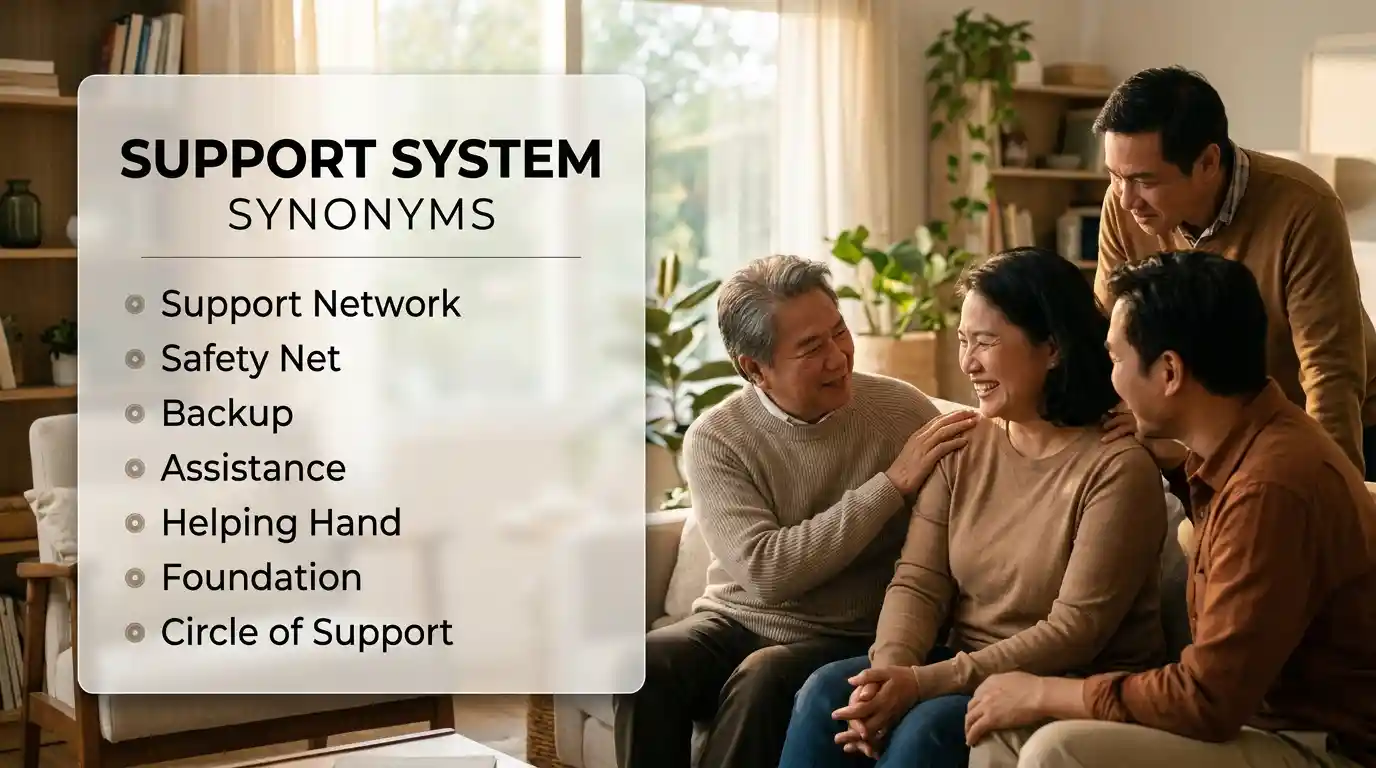
The best synonyms for support system include support network, safety net, support group, circle of support, community, helping network, care network, and reliable backing. These expressions describe people, services, or resources that provide emotional, practical, or financial help during difficult times. The best choice depends on the type of support involved.
When someone faces a difficult situation, they may turn to family, friends, colleagues, or a trusted community. These people offer encouragement, practical help, and reassurance when it matters most.
For example, support network may describe friends and relatives who provide emotional help, while care network often refers to people and services involved in someone’s well-being. Choosing the right expression makes the meaning clearer.
This guide explores useful alternatives, their differences, and their best uses for students, bloggers, content writers, and everyday English users.
What Does “Support System” Really Mean?
A support system is a group of people, organizations, or resources that help someone manage challenges and achieve personal or professional goals. It can provide emotional encouragement, practical assistance, financial help, guidance, or care.
The phrase is a noun phrase commonly used in conversations about relationships, health, education, work, and personal development. It usually has a positive meaning because it suggests that someone has reliable help and does not have to face difficulties alone.
Connotative Meaning
(Connotation is the feeling or association a word or phrase creates beyond its basic meaning.)
Support system generally carries a positive and reassuring tone.
- Positive: It suggests care, trust, encouragement, and dependable relationships.
- Neutral: It can describe an organized network of people or services that provide assistance.
- Negative: In some situations, it may highlight someone’s dependence on others or the absence of adequate support.
The phrase usually emphasizes cooperation and reliability rather than weakness or dependence.
Etymology & Pronunciation
Support comes through Old French supporter, from Latin supportare, meaning to carry or bear. System comes from Greek systēma, referring to an organized whole made up of connected parts.
Together, the words describe a connected group of people or resources that helps someone manage life’s demands.
- Support (US): /səˈpɔːrt/
- Support (UK): /səˈpɔːt/
- System (US): /ˈsɪstəm/
- System (UK): /ˈsɪstəm/
- Syllables: sup-port sys-tem
Synonyms for “Support System” — Grouped by Shade of Meaning
The most suitable alternative depends on who provides the help and what kind of assistance they offer. Some expressions emphasize personal relationships, while others describe professional services or practical resources.
1. Personal Relationships and Emotional Support
These expressions fit when friends, family members, or trusted people provide encouragement, understanding, and emotional reassurance.
- Support network — connected people offering help
- Circle of support — trusted people providing encouragement
- Support group — people sharing help and experiences
- Personal network — people available for personal assistance
- Helping community — people united to support others
- Trusted circle — reliable friends and family
- Inner circle — closest and most trusted people
- Network of care — people providing ongoing personal care
2. Safety, Stability, and Protection
Use these alternatives when the main purpose is to provide security, prevent hardship, or help someone recover from difficult circumstances.
- Safety net — protection against difficult situations
- Safety network — connected sources of protection
- Backup system — additional help when needed
- Protective network — people or services offering security
- Cushion of support — assistance that reduces hardship
- Reliable backing — dependable help and encouragement
- Safety structure — organized protection and assistance
3. Care and Assistance Networks
These phrases are suitable when support involves health care, social services, caregiving, or ongoing personal assistance.
- Care network — people and services providing care
- Care team — professionals working together to help
- Care community — people connected through shared care
- Assistance network — connected sources of practical help
- Help network — people or organizations offering assistance
- Care system — organized services providing care
- Social support network — relationships offering practical and emotional help
4. Guidance, Mentorship, and Encouragement
These alternatives work when the main purpose is helping someone make decisions, develop skills, or move toward a goal.
- Guidance network — people offering advice and direction
- Mentorship network — experienced people providing guidance
- Advisory circle — trusted people offering informed advice
- Guidance system — organized help with decisions
- Encouragement network — people providing motivation and reassurance
- Professional network — work-related contacts offering assistance
5. Practical and Organizational Support
Use these expressions when assistance comes from institutions, workplaces, communities, or organized resources rather than personal relationships alone.
- Resource network — connected sources of useful resources
- Assistance system — organized structure for providing help
- Community network — people and organizations working together
- Service network — connected services providing assistance
- Institutional support — help provided by an organization
- Support structure — organized arrangement of assistance
Example Sentences Using Different Alternatives
These examples show how different expressions can replace support system in natural situations.
- Her support network helped her stay confident during a challenging period.
- The scholarship program provides a safety net for students facing financial difficulties.
- The hospital created a care team to coordinate the patient’s treatment.
- New employees can benefit from a mentorship network during their first year.
- The local community network helped families recover after the flood.
- His trusted circle encouraged him to continue working toward his goals.
Synonyms by Tone
The tone of an alternative can make it sound personal, professional, formal, or community-focused.
| Tone | Suitable alternatives |
|---|---|
| Formal | Assistance network, care system, institutional support, resource network |
| Neutral | Support network, help network, care network, support structure |
| Warm and personal | Trusted circle, circle of support, helping community, inner circle |
| Professional | Mentorship network, professional network, advisory circle, care team |
| Protective | Safety net, protective network, backup system, reliable backing |
For personal conversations, trusted circle or support network often sounds natural. In reports and professional documents, assistance network or institutional support may be more suitable.
“Support System” vs. Close Alternatives
Several expressions are closely related, but they do not always describe the same type of help.
Support System vs. Support Network
A support system can include people, organizations, services, and practical resources. A support network usually emphasizes the connections between people who provide assistance.
Use support system for a broad arrangement of help. Choose support network when discussing relationships with friends, relatives, colleagues, or community members.
Support System vs. Safety Net
A support system provides ongoing help in different areas of life. A safety net usually refers to protection against hardship, financial difficulty, or unexpected problems.
For example, family members may form someone’s support system, while emergency financial assistance acts as a safety net.
Support System vs. Support Group
A support group is usually a specific group of people who meet or communicate to share experiences and encourage one another. A support system is broader and may include several different sources of help.
Use support group when referring to a particular group, such as people coping with grief or a health challenge. Use support system for the wider network of assistance around someone.
How “Support System” Changes by Context
The best replacement depends on the setting and the kind of assistance being discussed.
Daily Conversation
In everyday conversations, support network, trusted circle, and helping community are natural choices.
For example, “My friends and family are my strongest support network” sounds warm and clear.
Writing and Blogging
Bloggers can use circle of support, care network, and safety net to make articles about relationships, well-being, and personal growth more descriptive.
[internal link: synonyms for community → synonyms-for-community]
Professional or Academic Tone
In workplaces, education, and research, expressions such as mentorship network, professional network, assistance system, and institutional support can communicate the intended meaning more precisely.
For example, a university may establish a mentorship network to help new students adjust to academic life.
Creative or Informal Use
In personal essays, stories, and informal writing, expressions such as inner circle, trusted circle, and circle of support can create a warmer, more personal feeling.
For example, a character might rely on a small circle of trusted friends during a difficult chapter of life.
Common Mistakes Learners Make
Some related expressions describe only one part of a support system. Using them without considering their meaning can make a sentence inaccurate.
1. Treating a Support Group as a Complete Support System
A support group is only one possible part of a wider support system. It does not necessarily include family, professional services, or practical resources.
- Less precise: My support system consists only of my weekly support group.
- Clearer: My support system includes my family, friends, and weekly support group.
2. Using Safety Net for Every Type of Emotional Help
A safety net usually emphasizes protection from hardship rather than everyday emotional encouragement.
- Less suitable: My best friend is my emotional safety net in every conversation.
- Better: My best friend is an important part of my emotional support network.
3. Confusing a Professional Network with a Personal Support Network
A professional network mainly involves work-related relationships. It may provide career advice and opportunities, but it does not automatically offer personal or emotional care.
- Less precise: My professional network helps me through every personal difficulty.
- Better: My friends and family provide personal support when I need it.
4. Using Institutional Support for Help from Friends
Institutional support refers to assistance from organizations or formal institutions. It is not the right choice when describing help from close personal relationships.
- Incorrect: My siblings provide institutional support.
- Better: My siblings provide emotional and practical support.
5. Assuming Every Support System Is Made Up of People
A support system may also include services, financial resources, programs, and practical arrangements.
- Less complete: Her support system includes only her friends.
- Better: Her support system includes friends, counseling services, and financial assistance.
FAQs About Support System Synonyms
What Is the Closest Synonym for Support System?
Support network is usually the closest alternative. It commonly describes people connected through relationships who provide emotional, practical, or personal assistance.
What Is a Formal Alternative to Support System?
Assistance network, care system, and institutional support are suitable formal alternatives. The best choice depends on whether the help comes from an organized service, an institution, or a group of people.
What Is a Casual Alternative to Support System?
Trusted circle, helping community, and inner circle are natural casual alternatives. They work especially well when describing friends and family who offer encouragement.
What Is the Opposite of a Support System?
Possible opposites include lack of support, isolation, and absence of assistance. The best choice depends on whether you mean having no practical help, no emotional support, or no reliable connections.
Can Family Be Called a Support System?
Yes. Family members can form an important support system by offering emotional encouragement, practical assistance, guidance, and financial help. Friends, colleagues, and professional services may also be part of that system.
Conclusion
A good support system can make difficult situations easier to manage. Expressions such as support network, safety net, care network, and circle of support help describe different forms of assistance more accurately.
Try using these alternatives in essays, emails, blog posts, and everyday conversations. Think about whether you are describing emotional care, practical help, professional guidance, or protection before choosing a replacement.
To explore the meaning and related vocabulary further, visit the support system entry. Learning these expressions will help you communicate more clearly when writing about relationships, personal growth, and community care.

Daniel Mercer writes about measurements, dimensions, unit conversions, and the practical meaning of numbers in everyday life. His articles focus on explaining small and large measurements in clear language, using accurate conversions and useful comparisons to help readers develop an intuitive understanding of size and scale.