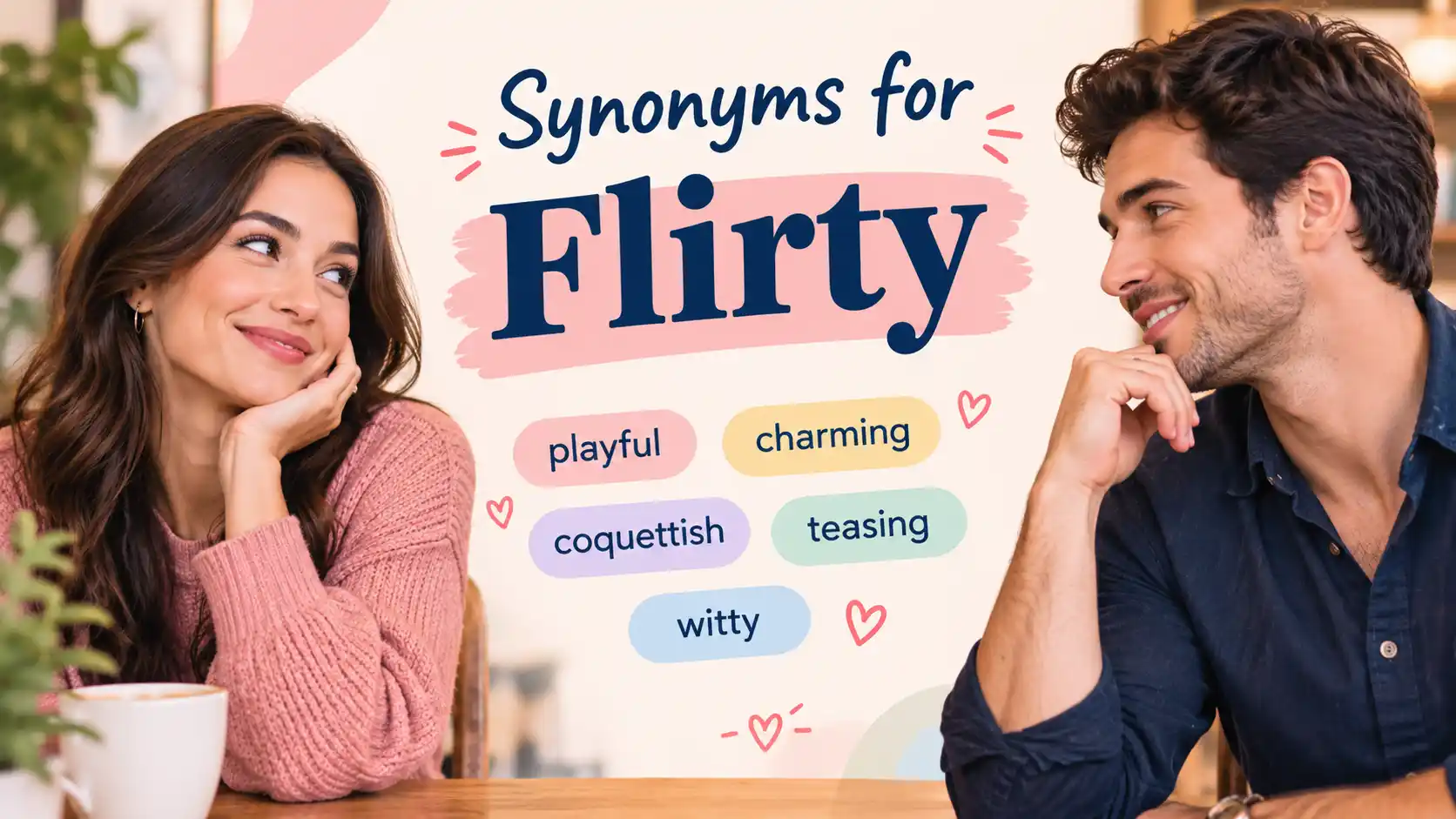
A clean, minimal landscape-style editorial illustration of two adults sharing a warm smile during a friendly conversation in a cozy café, with relaxed body language and subtle romantic tension. Soft natural lighting, tasteful colors, modern composition, no text, no logos, and no watermark.
When someone smiles suggestively, gives a playful compliment, or uses charming teasing to show romantic interest, the word flirty often describes the moment. Common alternatives include playful, teasing, coquettish, flirtatious, charming, and suggestive.
However, these words do not all mean exactly the same thing. A playful comment may be innocent, while a suggestive remark can imply romantic or sexual interest. Choosing the right alternative helps you express the intended tone without creating confusion.
This guide explores useful alternatives to flirty, explains their shades of meaning, and shows students, bloggers, content writers, and everyday English users how to choose the right word.
What Does “Flirty” Really Mean?
Flirty is an adjective describing behavior, language, or body language that playfully expresses or suggests romantic or sexual interest. A flirty person might smile warmly, exchange teasing remarks, give personal compliments, or use lighthearted conversation to attract someone’s attention.
The word can describe a person, message, glance, smile, conversation, or attitude. Its meaning depends on context: flirting may be lighthearted and friendly, openly romantic, or suggestive without being explicit.
Connotative Meaning of Flirty
Connotation refers to the feelings or associations a word carries beyond its basic definition.
- Positive: Charming, playful, and alluring can suggest appealing, enjoyable behavior.
- Neutral: Flirtatious can describe behavior without necessarily praising or criticizing it.
- Potentially negative: Teasing, provocative, or leading someone on may imply mixed signals or behavior that creates false expectations.
The same action can be interpreted differently by different people. Context, relationship, tone, and personal boundaries all influence how flirtation is understood.
Etymology and Pronunciation
Flirty comes from flirt combined with the adjective-forming suffix -y. The verb flirt appeared in English in the sixteenth century, although its earlier origins are uncertain. Today, it commonly refers to playful behavior that suggests attraction or romantic interest.
Pronunciation
- US English: /ˈflɝː.ti/
- UK English: /ˈflɜː.ti/
- Syllables: flirt-y (2 syllables)
Synonyms for Flirty — Grouped by Shade of Meaning
The best alternative depends on what kind of flirtation you mean. Some words emphasize playful teasing, others describe charm or attraction, and some suggest a more romantic or provocative tone.
1. Playful and Lighthearted Flirting
Use these words when the interaction feels fun, relaxed, and teasing rather than deeply romantic or intensely suggestive.
- Playful — fun, lighthearted, and mischievous.
- Teasing — gently provoking someone for amusement.
- Mischievous — playfully behaving as though breaking a small rule.
- Cheeky — boldly playful in a slightly impudent way.
- Coy — pretending to be shy or reluctant.
- Bantering — exchanging quick, playful remarks.
- Witty — using clever humor that can create attraction.
- Impish — displaying playful, slightly naughty humor.
- Lighthearted — relaxed, cheerful, and not overly serious.
2. Charming and Attractive Behavior
These alternatives emphasize the appeal or magnetism that can make flirting enjoyable. They do not always imply romantic intent on their own.
- Charming — pleasantly attractive in manner.
- Engaging — interesting and easy to connect with.
- Captivating — holding someone’s attention strongly.
- Alluring — attracting interest through an appealing quality.
- Enchanting — delightfully attractive or appealing.
- Magnetic — naturally drawing people’s attention.
- Winsome — sweetly and appealingly charming.
- Seductive — strongly inviting romantic or sexual interest.
- Irresistible — difficult to resist because of strong appeal.
3. Openly Romantic or Flirtatious
Choose these words when the behavior more clearly communicates attraction, romantic interest, or an intention to charm someone.
- Flirtatious — openly playful in showing attraction.
- Coquettish — playfully attracting attention, sometimes while appearing coy.
- Amorous — showing romantic or sexual desire.
- Romantic — expressing love or affectionate attraction.
- Lovestruck — strongly affected by romantic attraction.
- Smitten — deeply attracted or charmed by someone.
- Affectionate — expressing warmth, fondness, or tenderness.
- Courtly — showing formal, traditional romantic attention.
- Gallant — behaving with old-fashioned romantic courtesy.
4. Suggestive or Provocative Behavior
These terms fit situations where words, gestures, or expressions hint at attraction or carry a more daring meaning.
- Suggestive — hinting at romantic or sexual meaning.
- Provocative — deliberately stimulating interest or a reaction.
- Teasingly suggestive — hinting at attraction through playful remarks.
- Sultry — expressing intense, sensual attraction.
- Sensual — relating to physical pleasure or the senses.
- Smoldering — conveying restrained, intense attraction.
- Sultry-eyed — having a gaze perceived as sensual.
- Come-hither — inviting someone through a look or gesture.
Note: Some expressions above are descriptive phrases rather than single-word synonyms. Their suitability depends on the sentence and the intensity of the intended meaning.
5. Coy, Shy, or Subtly Flirtatious Behavior
These words suit situations where attraction is communicated indirectly through reserved behavior, shy smiles, or understated hints.
- Coyly playful — showing attraction with apparent shyness.
- Demure — modest or reserved in manner.
- Shy — hesitant or reserved around others.
- Bashful — showing embarrassment or shyness.
- Reserved — not openly expressing feelings.
- Understated — subtle rather than obvious.
- Teasingly coy — mixing playful hints with apparent reluctance.
These terms are not all direct synonyms. For example, shy and reserved describe personality or behavior but do not necessarily indicate flirting.
Example Sentences Using Flirty Alternatives
- Their playful conversation made the long wait feel much shorter.
- He gave her a charming smile before asking whether she wanted another coffee.
- Her coquettish manner made it difficult to tell whether she was joking or genuinely interested.
- The message sounded suggestive, so she asked what he meant before replying.
- They exchanged teasing remarks throughout the evening, keeping the conversation lively.
Synonyms for Flirty by Tone
Tone helps you select a word that suits your audience and the situation.
- Casual and playful: playful, teasing, cheeky, mischievous, lighthearted.
- Warm and charming: charming, engaging, captivating, winsome, magnetic.
- Romantic: flirtatious, amorous, smitten, affectionate, romantic.
- Formal or literary: coquettish, demure, gallant, courtly, alluring.
- Suggestive or sensual: provocative, suggestive, seductive, sultry, sensual.
Words such as seductive and provocative are stronger than playful. Use them when the context genuinely supports a more intense meaning.
Flirty vs. Close Alternatives
Flirty vs. Flirtatious
Both words describe behavior that suggests attraction. Flirty is more conversational and common in everyday speech, while flirtatious can sound slightly more formal or descriptive.
Use flirty message in casual writing and flirtatious behavior in a more formal discussion.
Flirty vs. Playful
Playful means fun and lighthearted, but it does not necessarily involve attraction. Flirty specifically suggests romantic or sexual interest.
Two friends can have a playful conversation without flirting. If their jokes include signs of attraction, flirty may be more accurate.
Flirty vs. Seductive
Flirty often suggests light teasing or an attempt to attract attention. Seductive usually implies a stronger, more deliberate appeal intended to draw someone toward romantic or sexual interest.
A friendly compliment may be flirty, while a deliberately sensual look may be described as seductive.
Flirty vs. Coquettish
Coquettish describes behavior that attracts attention through coyness or playful romantic interest. It is less common in everyday conversation and can sound literary or old-fashioned.
Use flirty for straightforward, modern language. Choose coquettish when you specifically mean a coy, teasing style.
How “Flirty” Changes by Context
Daily Conversation
In everyday speech, playful, teasing, and flirtatious are useful alternatives. For example, you might describe a conversation as playful when it is fun, or flirty when it seems to contain mutual attraction.
Writing and Blogging
In lifestyle articles, relationship discussions, and character descriptions, words such as charming, coy, and coquettish can help convey different personalities. Avoid treating every friendly gesture as evidence of romantic interest.
Internal link suggestion: [internal link: synonyms for charming → synonyms-for-charming]
Professional or Academic Writing
For a more objective discussion, flirtatious behavior is often clearer than informal expressions such as cheeky or saucy. Describe the specific words or actions where possible instead of assuming someone’s intentions.
Creative and Informal Use
In fiction, dialogue, and social posts, teasing, mischievous, alluring, and sultry can create distinct impressions. Choose according to the character’s behavior and the scene’s intensity rather than using stronger language simply for variety.
Internal link suggestion: [internal link: synonyms for playful → synonyms-for-playful]
Common Mistakes Learners Make
1. Treating “Playful” as an Exact Synonym
A playful person may simply enjoy jokes and friendly banter. The word does not automatically imply romantic interest.
Correction: Use flirty when attraction is part of the meaning; use playful when the interaction is mainly fun.
2. Using “Seductive” for Innocent Behavior
Seductive often carries a stronger romantic or sexual implication than flirty. Applying it to a harmless smile may exaggerate the situation.
Correction: Choose charming or playful when the behavior is lighthearted and not strongly suggestive.
3. Confusing “Coy” with “Shy”
A shy person may feel uncomfortable expressing themselves. Someone who is coy may appear reserved or reluctant in a way that playfully invites attention.
Correction: Use shy for general nervousness and coy when the context suggests deliberate or teasing reserve.
4. Assuming Friendly Behavior Always Means Attraction
Smiling, joking, and giving compliments can be ordinary signs of friendliness. They do not prove that someone is flirting.
Correction: Describe observable behavior and avoid claiming romantic intent without enough context.
5. Choosing an Overly Formal Word for Casual Conversation
Words such as coquettish and courtly can sound unusual in everyday texting.
Correction: Use flirty, playful, or teasing in casual conversation, reserving more literary terms for suitable contexts.
Frequently Asked Questions
What Is the Closest Synonym for Flirty?
Flirtatious is usually the closest direct synonym for flirty. Both describe behavior, language, or gestures that suggest romantic or sexual interest.
What Is a Formal Word for Flirty?
Flirtatious is a suitable alternative in formal or descriptive writing. Coquettish may fit when the behavior is specifically coy and playfully attention-seeking, although it is less common.
What Is a Casual Word for Flirty?
Playful or teasing can work in casual conversation when the interaction feels lighthearted. However, these words do not necessarily imply attraction, so flirty may be more precise when romantic interest is central.
What Is a More Romantic Word for Flirty?
Amorous can suggest romantic or sexual desire, while alluring emphasizes attractiveness. The best choice depends on whether you want to highlight the feeling, the person’s appeal, or the behavior.
What Is the Opposite of Flirty?
Possible opposites include reserved, uninterested, distant, and unresponsive, depending on the context. None is a perfect opposite in every situation: a reserved person may still feel attraction without expressing it openly.
Conclusion
Learning alternatives to flirty helps you describe attraction with greater precision. Words such as playful, charming, and teasing convey a light tone, while coquettish, seductive, and suggestive express more specific shades of behavior.
Try noticing how these words appear in conversations, stories, and everyday writing. Using the right alternative can make your descriptions sound more natural and help readers understand the tone you intend.
To explore the word’s definition and usage further, consult the flirty entry in Cambridge Dictionary. You can also expand your vocabulary with related topics such as synonyms for charming, synonyms for playful, and synonyms for attractive.

Daniel Mercer writes about measurements, dimensions, unit conversions, and the practical meaning of numbers in everyday life. His articles focus on explaining small and large measurements in clear language, using accurate conversions and useful comparisons to help readers develop an intuitive understanding of size and scale.