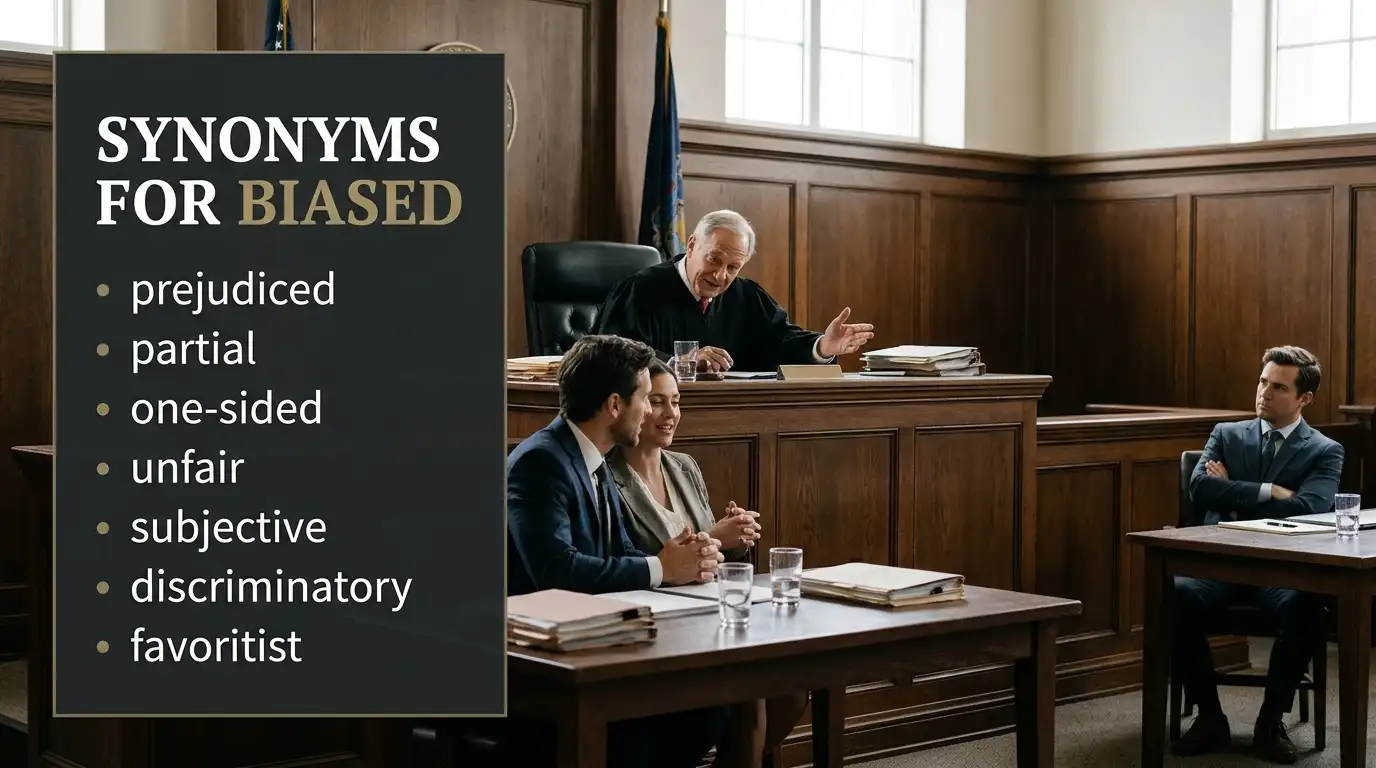
Synonyms for biased help you describe opinions, decisions, and reports that favor one person or side over another. Imagine reading a review that praises one product but ignores every problem. You might call it biased.
The word biased appears in news reports, school discussions, research, workplace decisions, product reviews, and everyday conversations. It often describes unfair judgment, but it can also refer to a preference that affects how someone sees a situation.
For example, a judge who favors one contestant without considering the evidence may seem biased. A report that presents only one side of an argument may also be described as one-sided or partial.
Learning synonyms for biased helps students, bloggers, content writers, and everyday English users express these ideas more precisely. Words such as prejudiced, unfair, partial, and slanted have related meanings, but each fits a different context.
What Does “Biased” Really Mean?
Biased means showing an unfair preference for or against a person, group, idea, or option. It describes a judgment or presentation that does not treat relevant sides fairly.
For example, a reviewer may be biased if they recommend a product only because a friend owns the company. A news report may seem biased if it highlights evidence for one position while ignoring important evidence against it.
Native English speakers commonly use biased when discussing fairness, decision-making, research, media, relationships, and public debate. The word often suggests that personal feelings, assumptions, interests, or preferences influence a judgment.
However, biased does not always mean someone deliberately acts unfairly. A person may have an unconscious bias without realizing it.
Part of Speech
Biased is an adjective. It describes a person, opinion, decision, report, test, or process that shows a preference for one side.
- “The article presents a biased view of the disagreement.”
- “The interviewer seemed biased toward one candidate.”
Biased can also function as the past-tense or past-participle form of the verb bias.
– “Personal interests biased his judgment.”
Connotative Meaning
Connotation (the emotional feeling or association a word carries beyond its basic meaning) affects how readers understand biased.
- Positive tone: The word is rarely positive by itself, but a clearly stated preference can sometimes be useful when someone openly supports a cause.
- Negative tone: Biased often suggests unfairness, prejudice, favoritism, or a lack of objectivity.
- Neutral tone: In statistics and research, bias can describe a systematic influence or error without implying deliberate wrongdoing.
The word’s meaning depends on context. Calling a news report biased is usually a criticism. Describing a statistical method as biased may instead identify a technical problem that researchers need to address.
Etymology of “Biased”
The word biased comes from bias, which entered English through French biais, meaning an oblique or slanting direction. The French term is associated with a sideways or diagonal position.
The figurative meaning developed from the idea of a slant. Just as a line can lean away from a straight direction, a person’s judgment can lean toward one side rather than remaining balanced.
Old English (450–1100)
The modern word bias was not part of the established Old English vocabulary in its present form. Old English had other words for inclination, judgment, and preference, but the modern term entered English later through French.
Middle English (1100–1500)
During Middle English, English adopted bias through French influence. The word first referred to a slanting direction and later developed associations with an inclination or tendency toward one side.
Modern English (1500–Present)
In Modern English, bias gained wider figurative uses in discussions of judgment, preferences, and unfair treatment. Today, biased appears in everyday speech, journalism, psychology, statistics, research, and public debate.
Pronunciation (US and UK – IPA)
- US: /ˈbaɪəst/
- UK: /ˈbaɪəst/
Syllables
bi-ased — 2 syllables
Affixation Pattern of “Biased”
- Root/base: bias
- Prefix: None
- Suffix: -ed, forming the adjective or past-participle form biased
The structure is bias + -ed = biased. In this word, the ending is pronounced /t/, not as a separate syllable.
Synonyms for Biased: 40 Words and Their Meanings
The best synonym for biased depends on the kind of preference or unfairness involved. Some words describe personal prejudice, others emphasize favoritism, and some focus on an unbalanced presentation of information.
1. Prejudiced
US: /ˈpredʒədɪst/ · UK: /ˈpredʒədɪst/
Meaning: Prejudiced describes someone who judges a person or group unfairly before considering the facts.
Examples:
- The manager made a prejudiced assumption about the applicant.
- She challenged the prejudiced comments during the meeting.
2. Partial
US: /ˈpɑːrʃəl/ · UK: /ˈpɑːʃəl/
Meaning: Partial describes someone who favors one person or side instead of judging fairly.
Examples:
- The referee appeared partial toward the home team.
- The committee must remain impartial when reviewing applications.
Usage note: In this sense, partial means showing favoritism. It can also mean incomplete, depending on context.
3. One-Sided
US: /ˌwʌn ˈsaɪdɪd/ · UK: /ˌwʌn ˈsaɪdɪd/
Meaning: One-sided describes an opinion, report, or argument that presents mainly one perspective.
Examples:
- The article gave a one-sided account of the dispute.
- Their discussion became one-sided because nobody listened to the other team.
4. Unfair
US: /ʌnˈfer/ · UK: /ʌnˈfeə/
Meaning: Unfair describes treatment or judgment that does not follow reasonable standards of fairness.
Examples:
- The students considered the selection process unfair.
- It is unfair to blame one employee for the whole team’s mistake.
5. Prejudicial
US: /ˌpredʒəˈdɪʃəl/ · UK: /ˌpredʒʊˈdɪʃəl/
Meaning: Prejudicial describes something that causes unfair disadvantage or influences judgment against someone.
Examples:
- The lawyer argued that the comment was prejudicial.
- The policy could have a prejudicial effect on certain applicants.
Usage note: This word often appears in legal and formal contexts. It can mean harmful to someone’s interests, not simply biased in opinion.
6. Slanted
US: /ˈslæntɪd/ · UK: /ˈslɑːntɪd/
Meaning: Slanted describes information presented in a way that favors a particular viewpoint.
Examples:
- The report offered a slanted interpretation of the survey.
- Readers criticized the slanted coverage of the election.
7. Subjective
US: /səbˈdʒektɪv/ · UK: /səbˈdʒektɪv/
Meaning: Subjective describes a judgment based mainly on personal feelings, opinions, or experiences.
Examples:
- Taste in music is highly subjective.
- The reviewer gave a subjective opinion rather than a measured comparison.
Usage note: Subjective does not automatically mean unfair. Personal judgment can be subjective without being biased.
8. Partisan
US: /ˈpɑːrtəzən/ · UK: /ˌpɑːtɪˈzæn/
Meaning: Partisan describes someone who strongly supports one side, especially in politics or a dispute.
Examples:
- The speech sounded partisan rather than balanced.
- The newspaper faced criticism for its partisan coverage.
9. Favoritist
US: /ˈfeɪvərɪtɪst/ · UK: /ˈfeɪvərɪtɪst/
Meaning: Favoritist describes a person or practice that gives unfair preference to particular people.
Examples:
- Employees complained about a favoritist approach to promotions.
- The committee promised to avoid favoritist decisions.
Usage note: This word is uncommon in modern English. Favoritism is more natural as a noun, while biased or favoring certain people usually works better as an adjective.
10. Favoring
US: /ˈfeɪvərɪŋ/ · UK: /ˈfeɪvərɪŋ/
Meaning: Favoring describes showing a preference for one person, option, or side.
Examples:
- The rules appeared to be favoring larger companies.
- The judge was accused of favoring one party.
Usage note: Favoring is a participle, not a direct adjective synonym in every sentence. It is useful for explaining what a biased decision does.
11. Discriminatory
US: /dɪˈskrɪmɪnətɔːri/ · UK: /dɪˈskrɪmɪnətəri/
Meaning: Discriminatory describes treatment that unfairly disadvantages people based on characteristics such as race, sex, age, or disability.
Examples:
- The organization reviewed its discriminatory hiring practices.
- The new policy was challenged as discriminatory.
Usage note: This word is stronger and more specific than biased. It is best used when unfair treatment or disadvantage is involved.
12. Bigoted
US: /ˈbɪɡətɪd/ · UK: /ˈbɪɡətɪd/
Meaning: Bigoted describes someone who strongly and unfairly rejects people with different beliefs or identities.
Examples:
- The speaker apologized for the bigoted remarks.
- A bigoted attitude can prevent honest discussion.
13. Intolerant
US: /ɪnˈtɑːlərənt/ · UK: /ɪnˈtɒlərənt/
Meaning: Intolerant describes someone unwilling to accept differences in beliefs, behavior, or identity.
Examples:
- The group rejected an intolerant attitude toward different cultures.
- He became intolerant of opinions that challenged his own.
14. Prepossessed
US: /ˌpriːpəˈzest/ · UK: /ˌpriːpəˈzest/
Meaning: Prepossessed can describe someone whose mind is already influenced by a particular idea or feeling.
Examples:
- The investigator tried not to become prepossessed by early theories.
- A prepossessed observer may interpret new evidence selectively.
Usage note: This is rare and may sound unnatural to many readers. Prefer prejudiced, predisposed, or already influenced in ordinary writing.
15. Unobjective
US: /ˌʌnəbˈdʒektɪv/ · UK: /ˌʌnəbˈdʒektɪv/
Meaning: Unobjective describes a judgment that does not assess a matter in a sufficiently impartial way.
Examples:
- The review seemed unobjective because it ignored negative feedback.
- The researcher revised the unobjective wording.
Usage note: Unobjective is less common than biased or not objective. Use the clearer alternatives when possible.
16. Nonobjective
US: /ˌnɑːnəbˈdʒektɪv/ · UK: /ˌnɒnəbˈdʒektɪv/
Meaning: Nonobjective describes something that does not rely on objective judgment or evidence.
Examples:
- The assessment included nonobjective criteria.
- The reviewer separated personal reactions from nonobjective claims.
Usage note: This is a technical-sounding term and is not always interchangeable with biased. Nonobjective can simply mean not based on objective measurement.
17. Preconceived
US: /ˌpriːkənˈsiːvd/ · UK: /ˌpriːkənˈsiːvd/
Meaning: Preconceived describes an opinion formed before someone has considered all the relevant information.
Examples:
- She entered the interview with a preconceived idea about the candidate.
- The research team tested its preconceived assumptions.
18. Opinionated
US: /əˈpɪnjəˌneɪtɪd/ · UK: /əˈpɪnjəneɪtɪd/
Meaning: Opinionated describes someone who expresses strong opinions and may be unwilling to reconsider them.
Examples:
- The columnist is opinionated but explains the reasoning behind each claim.
- His opinionated response made the discussion difficult.
Usage note: Having strong opinions does not necessarily make someone biased. The word describes how firmly someone holds or expresses opinions.
19. Dogmatic
US: /dɔːɡˈmætɪk/ · UK: /dɒɡˈmætɪk/
Meaning: Dogmatic describes someone who insists that their beliefs are correct and resists opposing evidence.
Examples:
- The professor warned against a dogmatic approach to research.
- His dogmatic response left little room for discussion.
20. Ideological
US: /ˌaɪdiəˈlɑːdʒɪkəl/ · UK: /ˌaɪdiəˈlɒdʒɪkəl/
Meaning: Ideological describes ideas or actions shaped by a particular system of beliefs.
Examples:
- The debate became ideological rather than practical.
- The report examined the ideological assumptions behind the policy.
Usage note: Ideological does not automatically mean biased. It becomes relevant when beliefs influence a judgment or presentation unfairly.
21. Preconditioned
US: /ˌpriːkənˈdɪʃənd/ · UK: /ˌpriːkənˈdɪʃənd/
Meaning: Preconditioned describes someone or something shaped in advance to respond in a particular way.
Examples:
- Years of advertising may have preconditioned consumers to prefer one brand.
- The interviewer tried to avoid preconditioned assumptions.
22. Predisposed
US: /ˌpriːdɪˈspoʊzd/ · UK: /ˌpriːdɪˈspəʊzd/
Meaning: Predisposed describes someone who is inclined to think or act in a particular way.
Examples:
- The reviewer was predisposed to like the director’s work.
- Previous experiences left him predisposed to distrust the proposal.
Usage note: A predisposition can influence judgment, but it does not always lead to unfairness.
23. Prejudging
US: /ˌpriːˈdʒʌdʒɪŋ/ · UK: /ˌpriːˈdʒʌdʒɪŋ/
Meaning: Prejudging means forming an opinion before considering all the relevant facts.
Examples:
- The panel avoided prejudging the applicant before the interview.
- Prejudging the results could weaken the investigation.
24. Unbalanced
US: /ʌnˈbælənst/ · UK: /ʌnˈbælənst/
Meaning: Unbalanced describes a presentation or judgment that gives unequal weight to important sides or factors.
Examples:
- The article provided an unbalanced view of the controversy.
- The evaluation was unbalanced because it ignored several achievements.
25. Skewed
US: /skjuːd/ · UK: /skjuːd/
Meaning: Skewed describes information or results distorted in a way that gives an inaccurate impression.
Examples:
- The small sample produced skewed survey results.
- Selective reporting created a skewed picture of the event.
26. Distorted
US: /dɪˈstɔːrtɪd/ · UK: /dɪˈstɔːtɪd/
Meaning: Distorted describes information that has been changed or presented in a way that misrepresents reality.
Examples:
- The headline gave a distorted impression of the research.
- He felt the article distorted his original statement.
27. Misleading
US: /mɪsˈliːdɪŋ/ · UK: /mɪsˈliːdɪŋ/
Meaning: Misleading describes information that gives people a false or inaccurate impression.
Examples:
- The advertisement used a misleading comparison.
- The chart was misleading because it left out the starting values.
Usage note: Misleading information can result from bias, but it can also be inaccurate for other reasons.
28. Slanted in Favor of
US: /ˈslæntɪd ɪn ˈfeɪvər əv/ · UK: /ˈslɑːntɪd ɪn ˈfeɪvə əv/
Meaning: Slanted in favor of describes a presentation that supports one side more than others.
Examples:
- The article was slanted in favor of the company’s position.
- The debate summary seemed slanted in favor of the winning team.
29. Skewed Toward
US: /skjuːd tɔːrd/ · UK: /skjuːd təˈwɔːd/
Meaning: Skewed toward describes a result, sample, or presentation that leans disproportionately in one direction.
Examples:
- The survey was skewed toward younger participants.
- The results were skewed toward people who already liked the product.
30. Colored
US: /ˈkʌlərd/ · UK: /ˈkʌləd/
Meaning: Colored describes an opinion or judgment influenced by feelings, beliefs, or personal interests.
Examples:
- Her memories were colored by years of family conflict.
- The report was colored by the author’s strong political views.
Usage note: This is figurative. Writers often say colored by personal experience or colored by prejudice rather than using colored alone.
31. Interested
US: /ˈɪntrəstɪd/ · UK: /ˈɪntrəstɪd/
Meaning: Interested can describe a person whose own benefit or involvement may influence their judgment.
Examples:
- The decision-maker was an interested party in the contract.
- An interested observer may struggle to judge the dispute impartially.
Usage note: Interested is not usually a direct synonym for biased. In formal contexts, an interested party has a personal stake in an outcome.
32. Self-Serving
US: /ˌselfˈsɜːrvɪŋ/ · UK: /ˌselfˈsɜːvɪŋ/
Meaning: Self-serving describes behavior or statements designed to benefit the person making them.
Examples:
- His self-serving explanation ignored his own mistakes.
- The report offered a self-serving account of the company’s actions.
33. Favorable
US: /ˈfeɪvərəbəl/ · UK: /ˈfeɪvərəbəl/
Meaning: Favorable describes an attitude or judgment that supports or approves of someone or something.
Examples:
- The reviewer gave the film a favorable assessment.
- The proposal received favorable comments from the committee.
Usage note: Favorable is not inherently negative. A positive judgment becomes biased only when unfair preference or inadequate consideration affects it.
34. Preferential
US: /ˌprefəˈrenʃəl/ · UK: /ˌprefəˈrenʃəl/
Meaning: Preferential describes treatment that gives one person or group an advantage over others.
Examples:
- The investigation examined preferential treatment in hiring.
- The rules prohibit preferential access for personal friends.
35. Disproportionate
US: /ˌdɪsprəˈpɔːrʃənət/ · UK: /ˌdɪsprəˈpɔːʃənət/
Meaning: Disproportionate describes something that is too large or small compared with what is reasonable or appropriate.
Examples:
- The report devoted disproportionate attention to one minor incident.
- Critics said the punishment was disproportionate to the mistake.
Usage note: Disproportionate describes an imbalance. It may indicate bias, but the imbalance could have another explanation.
36. Selective
US: /sɪˈlektɪv/ · UK: /sɪˈlektɪv/
Meaning: Selective describes choosing certain information or people while leaving others out.
Examples:
- The article used selective evidence to support its claim.
- The reviewer gave a selective account of the product’s performance.
Usage note: Selectivity can be appropriate when a task requires choosing relevant details. It suggests bias when the selection unfairly distorts the overall picture.
37. Discerning
US: /dɪˈsɜːrnɪŋ/ · UK: /dɪˈsɜːnɪŋ/
Meaning: Discerning describes someone who makes careful judgments and recognizes important differences.
Examples:
- A discerning reader checks the source before accepting a claim.
- The discerning reviewer considered both strengths and weaknesses.
Usage note: This is generally positive, not a synonym for biased. It is useful as a contrast because careful judgment aims to avoid unfair preferences.
38. Unjust
US: /ʌnˈdʒʌst/ · UK: /ʌnˈdʒʌst/
Meaning: Unjust describes treatment or a decision that violates fairness or justice.
Examples:
- The workers protested against the unjust dismissal.
- The policy created an unjust burden for low-income families.
39. Prejudiced Against
US: /ˈpredʒədɪst əˈɡenst/ · UK: /ˈpredʒədɪst əˈɡenst/
Meaning: Prejudiced against describes holding an unfair negative opinion of someone or a group.
Examples:
- The supervisor appeared prejudiced against older applicants.
- The organization trained staff to recognize attitudes prejudiced against minority groups.
40. Biased in Favor of
US: /ˈbaɪəst ɪn ˈfeɪvər əv/ · UK: /ˈbaɪəst ɪn ˈfeɪvə əv/
Meaning: Biased in favor of describes a preference that unfairly supports a particular person, group, or option.
Examples:
- The selection process seemed biased in favor of internal candidates.
- The report was biased in favor of the sponsor’s position.
Synonyms for Biased by Tone
The word you choose can make a criticism sound mild, formal, or serious. Understanding tone helps you describe unfair judgment without exaggerating what happened.
Neutral or Analytical Tone
These words describe the influence of preferences or the balance of information without necessarily accusing someone of deliberate wrongdoing.
- Subjective: Based on personal feelings or opinions.
- Skewed: Distorted toward a particular result or direction.
- Selective: Based on choosing certain information or examples.
- Unbalanced: Giving unequal attention to relevant sides.
- Predisposed: Inclined toward a particular view before considering all the evidence.
Example: “The survey results were skewed because most participants came from the same age group.”
Negative or Critical Tone
These words suggest unfairness, prejudice, or a failure to judge people or ideas fairly.
- Prejudiced: Judging people unfairly based on assumptions.
- Unfair: Not treating people or situations justly.
- Bigoted: Holding strong, intolerant prejudices.
- Discriminatory: Unfairly disadvantaging a person or group.
- Self-serving: Presenting information to benefit oneself.
- Unjust: Violating principles of fairness or justice.
Example: “The committee rejected the discriminatory policy after reviewing its effects.”
Formal or Professional Tone
These terms suit research, policy discussions, legal writing, and professional reviews.
- Partisan: Strongly supporting one side, often in politics.
- Prejudicial: Causing unfair disadvantage or influencing judgment against someone.
- Preferential: Giving one person or group special treatment.
- Disproportionate: Giving too much or too little attention or weight to something.
- One-sided: Presenting mainly one perspective.
Example: “The researcher identified a potential source of sampling bias in the study.”
Informal or Everyday Tone
These expressions work well in conversations and accessible writing.
- Slanted: Showing a preference for one side.
- One-sided: Ignoring or minimizing other perspectives.
- Unfair: Treating someone or something unjustly.
- Favoring one side: Supporting one party more than another.
Example: “That review seems one-sided because it only mentions the product’s good points.”
Why tone matters: Biased is a broad term. Prejudiced often suggests unfair assumptions about people, while slanted describes the presentation of information. Choosing the right word makes your meaning more precise.
“Biased” vs. Close Alternatives
| Word | Main meaning | Tone | Best use |
|---|---|---|---|
| Biased | Influenced by a preference that may affect fairness | General, often critical | Opinions, decisions, reports |
| Prejudiced | Judging someone unfairly before considering the facts | Strongly critical | People, groups, assumptions |
| Partial | Favoring one side or person | Formal or neutral | Judges, referees, decision-makers |
| One-sided | Showing mainly one perspective | Direct and critical | Articles, arguments, reports |
| Subjective | Based on personal feelings or opinions | Neutral or analytical | Reviews, art, personal judgments |
Biased vs. Prejudiced
The term Biased covers a wide range of preferences and influences. A reviewer can be biased toward a favorite brand, even without holding a deep prejudice.
Prejudiced more often refers to an unfair judgment formed before someone properly considers the facts. It is especially common when discussing assumptions about people or groups.
- “The review was biased toward the more expensive product.”
- “The interviewer made a prejudiced assumption about the applicant.”
Biased vs. Partial
Partial can mean favoring one person or side. In this sense, it is close to biased, but it often appears in discussions of judges, referees, and decision-makers.
- “The referee seemed partial toward the home team.”
- “The referee seemed biased in favor of the home team.”
Both sentences suggest favoritism. The first sounds slightly more formal.
Biased vs. One-Sided
One-sided focuses on how information or arguments are presented. It suggests that one perspective receives attention while others receive little or none.
- “The report was biased.”
- “The report was one-sided because it ignored the opposing evidence.”
The second sentence explains how the bias appears in the report. However, an incomplete report is not always biased; the writer may simply have had limited information.
How “Biased” Changes by Context
Daily Conversation
In everyday speech, biased, unfair, and one-sided are common choices. They help people explain why a decision, opinion, or argument does not seem balanced.
For example, someone might say, “You’re biased because you always support your favorite team.” A friend discussing a disagreement might say, “That sounds one-sided. What did the other person say?”
Use simple alternatives when they communicate the point clearly. You do not need a formal word for every disagreement.
Writing and Blogging
Bloggers use biased, slanted, subjective, and misleading when discussing reviews, news coverage, product comparisons, and public opinions.
Choose slanted when the presentation favors one side. Use subjective when a judgment depends on personal taste. Choose misleading when the information creates a false impression.
Writers should also distinguish between a claim that is biased and a claim that is simply incorrect. The two problems can overlap, but they are not identical.
Professional or Academic Writing
In research, bias can refer to systematic influences that affect sampling, measurement, analysis, or interpretation. A biased sample, for example, may not represent the population that a researcher wants to understand.
In workplace discussions, partial, preferential, and discriminatory can describe different concerns. Use discriminatory when treatment unfairly disadvantages people based on relevant protected or personal characteristics.
Avoid accusing someone of deliberate misconduct without evidence. A decision can show bias even when the person making it did not intend to act unfairly.
Creative or Informal Writing
In stories, biased, prejudiced, and partisan can help develop a character’s beliefs and conflicts. A character who always defends one family member may seem biased, while a character who judges strangers based on stereotypes may seem prejudiced.
For a lighter, conversational tone, one-sided or slanted can describe an argument without making the dialogue sound overly formal.
Common Mistakes Learners Make
1. Treating “Biased” and “Wrong” as the Same
A biased opinion is influenced by a preference, assumption, or interest. That does not automatically make every conclusion in it false.
For example, a reviewer may favor one brand but still make a correct statement about its battery life. Assess the evidence instead of assuming that every biased source is wrong.
2. Using “Subjective” as a Direct Replacement Every Time
A subjective judgment depends on personal feelings or experience. It may still be reasonable and fair.
A film review is subjective because it reflects the reviewer’s taste. It becomes biased if the reviewer unfairly favors one film or deliberately ignores relevant evidence.
3. Confusing “Partial” With “Incomplete”
Partial has two common meanings. It can mean favoring one side, or it can mean incomplete.
- Favoritism: “The referee appeared partial toward the home team.”
- Incomplete: “We received only a partial report.”
Use the surrounding context to determine which meaning applies.
4. Using “Discriminatory” Too Broadly
A biased decision is not always discriminatory. Discriminatory is more specific and often involves unfair treatment that disadvantages people based on characteristics such as age, disability, sex, or race.
Use the word when the situation supports that meaning. Otherwise, biased, unfair, or preferential may be more accurate.
5. Assuming All Bias Is Deliberate
People can show unconscious bias without intending to favor anyone. Familiarity, past experiences, assumptions, and incomplete information can affect judgment.
When intent is unclear, describe the evidence: “The process may favor internal applicants” is often more precise than “The manager deliberately discriminated.”
6. Overusing Negative Synonyms
Words such as bigoted, prejudiced, and discriminatory carry strong criticism. They are not interchangeable with milder terms such as subjective or partial.
Choose a word that matches the actual behavior. Strong language is appropriate when supported by evidence, but exaggeration can weaken your argument.
Register Notes: Formal vs. Informal
- Formal: prejudicial, partisan, discriminatory, preferential
- Neutral or analytical: subjective, predisposed, skewed, unbalanced
- Direct and conversational: biased, unfair, one-sided
- Strongly critical: prejudiced, bigoted, unjust, self-serving
In professional writing, explain the reason for calling something biased. Identifying the missing evidence, unequal treatment, or personal interest makes the criticism clearer and more credible.
Real-Life Scenarios Using Biased Synonyms
Workplace
A manager repeatedly promotes employees they know personally while overlooking stronger candidates. Workers might describe the decisions as partial or favoritist. If the process systematically gives certain employees an unfair advantage, preferential treatment is a more natural phrase.
Social Situations
Two friends disagree about a family argument. One friend hears only one person’s account and immediately takes that person’s side. Their opinion may be one-sided or biased because they have not considered the other person’s perspective.
Media and Pop Culture
A news program discusses a political issue but repeatedly highlights one party’s claims while dismissing the opposing side. Viewers might call the coverage partisan, slanted, or unbalanced.
The best term depends on what the coverage actually does. Partisan emphasizes strong support for a side, while unbalanced emphasizes unequal presentation.
Writing and Storytelling
A novelist creates a narrator who praises a close friend but criticizes every rival. The narrator may be partial toward the friend or subjective in their descriptions.
If the narrator judges an entire group through stereotypes, prejudiced may fit better. Such word choices help readers understand the character’s perspective without lengthy explanations.
Practice Exercise: Choose the Best Synonym
Choose the word that best describes each situation. Pay attention to whether it involves unfair judgment, personal opinion, favoritism, or an unbalanced presentation.
Multiple-Choice Questions
1. A news article discusses only the benefits of a policy and ignores all opposing arguments. Which word fits best?
A. Subjective
B. One-sided
C. Discerning
D. Unanticipated
2. A manager assumes that an applicant cannot do the job because of the applicant’s background. Which word best describes the assumption?
A. Favorable
B. Selective
C. Prejudiced
D. Subjective
3. A referee repeatedly makes decisions in favor of the home team. Which word best describes the referee?
A. Partial
B. Discerning
C. Unbalanced
D. Preconditioned
4. A survey includes mostly people who already support a particular product. What might this make the results?
A. Unconventional
B. Favorable
C. Objective
D. Skewed
5. A film reviewer gives an opinion based on personal taste. Which word best describes the opinion if it is not necessarily unfair?
A. Discriminatory
B. Subjective
C. Bigoted
D. Self-serving
6. A company gives certain employees special advantages over equally qualified colleagues. Which term fits best?
A. Unanticipated treatment
B. Subjective treatment
C. Preferential treatment
D. Discerning treatment
7. A speaker refuses to accept people with different beliefs and expresses hostility toward them. Which word fits best?
A. Bigoted
B. Selective
C. Partial
D. Favorable
8. A report presents facts in a way that creates a false impression. Which word best describes the report?
A. Opinionated
B. Discerning
C. Unconventional
D. Misleading
9. A researcher chooses evidence that supports a theory but ignores evidence that challenges it. Which phrase best describes this approach?
A. Disproportionate punishment
B. Selective evidence
C. Favorable treatment
D. Unanticipated evidence
10. A person strongly supports a political party and consistently defends its policies. Which word best describes the person’s approach to political discussion?
A. Unjust
B. Subjective
C. Partisan
D. Discerning
11. A decision unfairly disadvantages applicants from a particular group. Which word most directly describes the decision if the unfair treatment is based on group membership?
A. Discriminatory
B. Opinionated
C. Favorable
D. Unconventional
12. A reviewer prefers one brand because a close friend owns it, even though competing products perform better. Which word best describes the review?
A. Objective
B. Discerning
C. Unanticipated
D. Biased
Reflection and Application Task
Write three original sentences using biased, prejudiced, and one-sided. Use a different situation for each word, such as a product review, a hiring decision, or a disagreement between friends.
Then explain why each word fits the situation. Consider whether the problem involves favoritism, an unfair assumption, or an incomplete presentation of the facts.
Answer Key: 1-B, 2-C, 3-A, 4-D, 5-B, 6-C, 7-A, 8-D, 9-B, 10-C, 11-A, 12-D.
Conclusion
Learning synonyms for biased helps you describe unfair judgments, favoritism, and unbalanced information more accurately. Each alternative highlights a different aspect of the problem.
Words such as prejudiced, partial, slanted, and subjective help you express your meaning without repeating the same term. Choosing carefully also makes your criticism more precise and fair.
A stronger vocabulary improves essays, blogs, workplace emails, and everyday conversations. It helps you explain different viewpoints clearly while separating personal opinions from evidence.
Practice these words in your own sentences, emails, and essays. Explore biased, then use synonyms for biased in a real-life example to strengthen your vocabulary and communication skills.

Daniel Mercer writes about measurements, dimensions, unit conversions, and the practical meaning of numbers in everyday life. His articles focus on explaining small and large measurements in clear language, using accurate conversions and useful comparisons to help readers develop an intuitive understanding of size and scale.