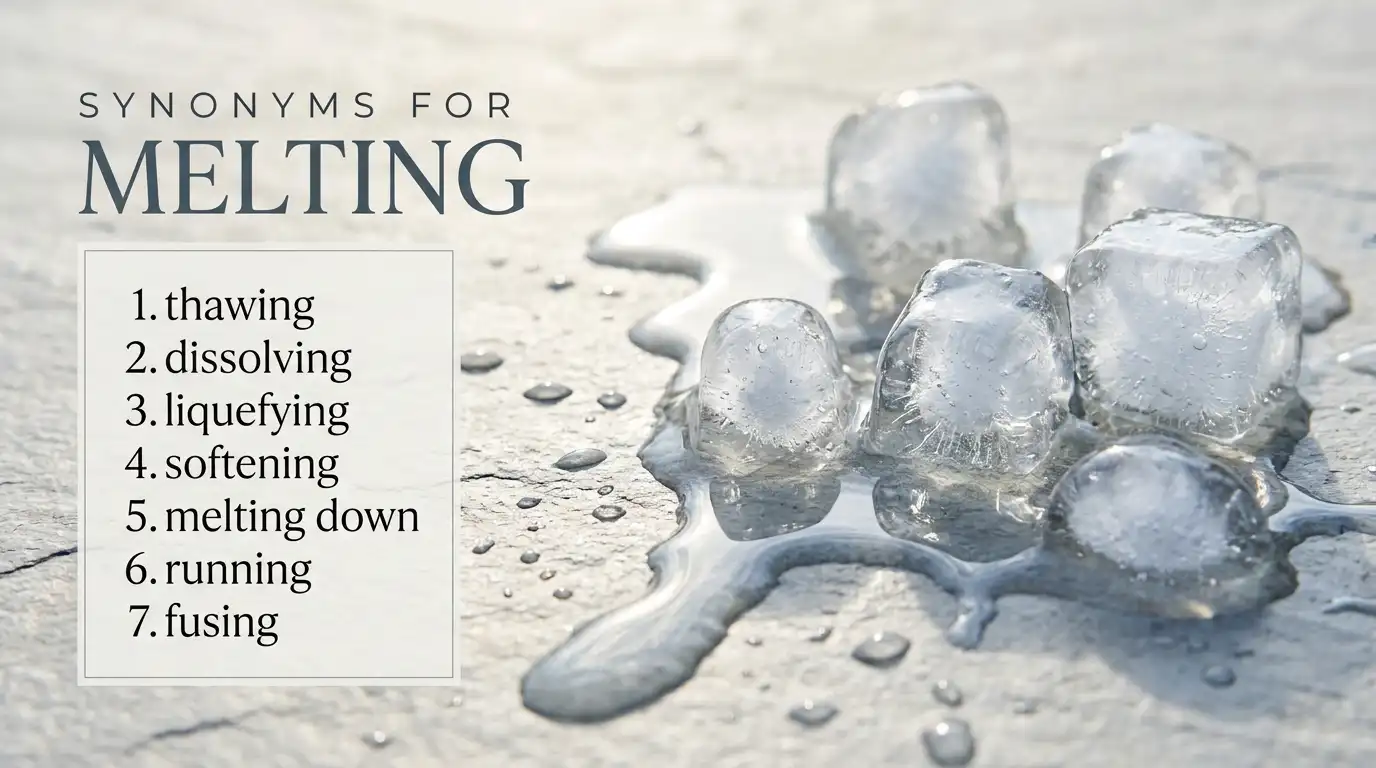
Synonyms for melting help you describe what happens when ice turns into water, butter becomes soft, or chocolate loses its solid shape. Choosing the right word makes your writing clearer and more precise.
Imagine leaving an ice cream cone in the sun. It begins to soften, drip, and eventually lose its shape. You might call this melting, but other words can describe different stages of the process.
Learning synonyms for melting helps students, bloggers, content writers, and everyday English users explain changes in materials, weather, cooking, and nature. Some alternatives describe a scientific process, while others sound more casual.
In this guide, you will explore useful alternatives, simple definitions, pronunciation, and real-life examples. You will also learn when words such as thawing, liquefying, and softening are appropriate.
What Does “Melting” Really Mean?
Melting usually means the process in which a solid changes into a liquid because it gains heat. Ice melting into water is a familiar example.
The word can also describe something becoming softer or losing its firm shape. In figurative English, melting may express warmth, tenderness, or a strong emotional response.
For example, a block of ice melts in a warm room. Chocolate melts when heated, while a person might describe a touching story as “heart-melting.”
Part of Speech
Melting can function as a noun-like gerund, a present participle of the verb melt, or an adjective.
- Verb: The snow is melting.
- Noun-like gerund: Melting takes time in a cold room.
- Adjective: She gave him a melting smile.
Connotative Meaning
(Connotation means the feelings or associations a word carries beyond its basic meaning.)
- Positive tone: Melting can suggest tenderness, affection, comfort, or emotional warmth.
- Negative tone: It may suggest damage, loss, or an unwanted change, such as melting plastic near a heat source.
- Neutral tone: In science and everyday descriptions, it simply refers to a change from a solid to a liquid.
The meaning depends on the subject and situation. Melting ice is a physical process, while a melting heart is a figurative expression.
Etymology of Melting
The word melting comes from the verb melt, which has Germanic roots. Its history is connected to words describing the softening or liquefying of materials.
Old English (450–1100)
Old English had the verb meltan, meaning to melt or become liquid. It was used to describe physical changes involving substances that softened or liquefied.
Middle English (1100–1500)
During the Middle English period, forms such as melten continued to be used. The spelling and pronunciation gradually developed toward the modern English word melt.
Modern English (1500–Present)
In Modern English, melt became a common verb for describing the transition from solid to liquid. Its figurative meanings also expanded, allowing writers to describe emotions, affection, and the gradual disappearance of something.
Pronunciation, Syllables, and Word Structure
- US pronunciation: /ˈmɛltɪŋ/
- UK pronunciation: /ˈmɛltɪŋ/
- Syllables: melt-ing
- Part of speech: Verb form, gerund, or adjective
- Root: Melt
- Prefix: None
- Suffix: -ing
Common forms include melt, melts, melted, melting, and meltdown. The noun melting can refer to the process itself, as in “the melting of the ice.”
40 Synonyms for Melting: Meanings and Examples
The best alternative depends on what is melting. Ice may thaw, chocolate may soften, and a solid metal may liquefy under suitable conditions.
Some words below are close synonyms. Others describe a particular stage, result, or related process. The explanations identify where each word fits so you can avoid using an inaccurate replacement.
1. Thaw
US: /θɔː/ | UK: /θɔː/
Meaning: To become warmer and change from a frozen state, often as ice or snow begins to melt.
Examples:
- The frozen ground began to thaw in spring.
- Leave the frozen berries in the refrigerator to thaw.
2. Liquefy
US: /ˈlɪkwɪfaɪ/ | UK: /ˈlɪkwɪfaɪ/
Meaning: To change a solid or gas into a liquid under suitable conditions.
Examples:
- The heat caused the solid material to liquefy.
- The factory uses a controlled process to liquefy certain materials.
3. Soften
US: /ˈsɔːfən/ | UK: /ˈsɒfən/
Meaning: To become less hard or firm, whether or not the material becomes liquid.
Examples:
- Leave the butter out to soften before baking.
- The chocolate softened in the warm kitchen.
4. Dissolve
US: /dɪˈzɑːlv/ | UK: /dɪˈzɒlv/
Meaning: To mix into a liquid and form a solution.
Examples:
- Stir the sugar until it dissolves in the tea.
- The powder dissolves quickly in warm water.
Usage note: Dissolving is different from melting. Sugar dissolves in water, but ice melts into liquid water.
5. Defrost
US: /diːˈfrɔːst/ | UK: /diːˈfrɒst/
Meaning: To remove frost or allow something frozen to warm up and become unfrozen.
Examples:
- I need to defrost the freezer this afternoon.
- Defrost the frozen bread before serving it.
6. Unfreeze
US: /ʌnˈfriːz/ | UK: /ʌnˈfriːz/
Meaning: To change something from a frozen state back to an unfrozen state.
Examples:
- Let the frozen vegetables unfreeze before cooking.
- The pipes began to unfreeze as the temperature rose.
7. Run
US: /rʌn/ | UK: /rʌn/
Meaning: To flow like a liquid, especially when a solid substance melts.
Examples:
- The candle wax began to run down the holder.
- The cheese ran across the hot pizza.
8. Drip
US: /drɪp/ | UK: /drɪp/
Meaning: To fall in small drops of liquid, often after a substance melts.
Examples:
- Water dripped from the melting icicle.
- The ice cream began to drip onto my hand.
9. Melt Away
US: /mɛlt əˈweɪ/ | UK: /mɛlt əˈweɪ/
Meaning: To gradually disappear through melting or to seem to disappear figuratively.
Examples:
- The last patches of snow melted away.
- Her worries seemed to melt away during the holiday.
10. Become Liquid
US: /bɪˈkʌm ˈlɪkwɪd/ | UK: /bɪˈkʌm ˈlɪkwɪd/
Meaning: To change from a solid state into a liquid state.
Examples:
- The wax became liquid near the flame.
- The substance becomes liquid when heated sufficiently.
11. Turn to Liquid
US: /tɜːrn tə ˈlɪkwɪd/ | UK: /tɜːn tə ˈlɪkwɪd/
Meaning: To change into liquid form, usually because of heat.
Examples:
- The butter turned to liquid in the hot pan.
- The ice turned to liquid on the sunny windowsill.
12. Melt Down
US: /mɛlt daʊn/ | UK: /mɛlt daʊn/
Meaning: To melt a material completely or reduce it to a liquid through heating.
Examples:
- The workers melted down the scrap metal for reuse.
- We melted down the old candle ends to make a new candle.
Usage note: In everyday English, meltdown can also refer to an emotional outburst or a serious system failure. Context determines the meaning.
13. Liquefaction
US: /ˌlɪkwəˈfækʃən/ | UK: /ˌlɪkwɪˈfækʃən/
Meaning: The process of changing a substance into a liquid or causing soil to behave like a liquid under particular conditions.
Examples:
- The report examined the liquefaction of the heated material.
- Earthquake-related soil liquefaction can damage buildings.
Usage note: This is a technical noun, not a direct replacement for the verb melting in ordinary sentences.
14. Melt Down Into Liquid
US: /mɛlt daʊn ˈɪntuː ˈlɪkwɪd/ | UK: /mɛlt daʊn ˈɪntʊ ˈlɪkwɪd/
Meaning: To become liquid through a melting process.
Examples:
- The solid wax melted down into liquid.
- The material melted down into liquid under controlled heating.
15. Fuse
US: /fjuːz/ | UK: /fjuːz/
Meaning: To join or combine substances or parts, sometimes through heat that melts their surfaces.
Examples:
- Heat caused the plastic pieces to fuse together.
- The metal edges fused during welding.
Usage note: Fusion means joining or combining. It does not always mean melting.
16. Run Off
US: /rʌn ɔːf/ | UK: /rʌn ɒf/
Meaning: To flow away from a surface, often as snow or ice melts into water.
Examples:
- Meltwater ran off the roof.
- The water ran off the driveway after the snow melted.
17. Flow
US: /floʊ/ | UK: /fləʊ/
Meaning: To move continuously as a liquid, including a substance that has melted.
Examples:
- The molten glass flowed into the mold.
- Melted butter flowed across the warm bread.
18. Become Molten
US: /bɪˈkʌm ˈmoʊltən/ | UK: /bɪˈkʌm ˈməʊltən/
Meaning: To become a hot liquid after a solid material melts.
Examples:
- The metal became molten inside the furnace.
- The glass became molten before the artist shaped it.
19. Melt Completely
US: /mɛlt kəmˈpliːtli/ | UK: /mɛlt kəmˈpliːtli/
Meaning: To change fully from a solid into a liquid.
Examples:
- The ice cubes melted completely in the warm drink.
- Allow the chocolate to melt completely before mixing it.
20. Thaw Out
US: /θɔː aʊt/ | UK: /θɔː aʊt/
Meaning: To become unfrozen or allow something frozen to warm up.
Examples:
- The frozen road began to thaw out by noon.
- I took the chicken out to thaw out safely in the refrigerator.
21. Unfreeze Completely
US: /ʌnˈfriːz kəmˈpliːtli/ | UK: /ʌnˈfriːz kəmˈpliːtli/
Meaning: To return fully from a frozen state to an unfrozen state.
Examples:
- Wait until the frozen berries unfreeze completely.
- The pipes took several hours to unfreeze completely.
22. Soften Up
US: /ˈsɔːfən ʌp/ | UK: /ˈsɒfən ʌp/
Meaning: To become softer or less firm, especially because of warmth or moisture.
Examples:
- The butter softened up on the counter.
- Warm the caramel until it softens up.
23. Become Runny
US: /bɪˈkʌm ˈrʌni/ | UK: /bɪˈkʌm ˈrʌni/
Meaning: To become less thick and more fluid, sometimes because of melting.
Examples:
- The icing became runny in the heat.
- The cheese became runny inside the toasted sandwich.
24. Melt Into
US: /mɛlt ˈɪntuː/ | UK: /mɛlt ˈɪntʊ/
Meaning: To gradually blend into something else through melting or to merge figuratively.
Examples:
- The butter melted into the hot sauce.
- The pink sky melted into shades of orange.
25. Blend
US: /blɛnd/ | UK: /blɛnd/
Meaning: To mix smoothly with another substance, sometimes after melting.
Examples:
- The melted chocolate blended with the cream.
- Stir gently until the ingredients blend together.
Usage note: Blending describes mixing, not the melting process itself.
26. Merge
US: /mɜːrdʒ/ | UK: /mɜːdʒ/
Meaning: To combine or join into one, especially in figurative descriptions.
Examples:
- The snow-covered hills merged into the mist.
- The colors merged as the ice sculpture began to melt.
Usage note: This is a figurative or contextual alternative, not a physical synonym for melting in every case.
27. Fade Away
US: /feɪd əˈweɪ/ | UK: /feɪd əˈweɪ/
Meaning: To gradually become weaker, less visible, or less noticeable.
Examples:
- The snow’s white patches faded away as spring arrived.
- The frost faded away in the morning sunshine.
Usage note: The frost may melt, but fade away emphasizes its gradual disappearance.
28. Disappear
US: /ˌdɪsəˈpɪr/ | UK: /ˌdɪsəˈpɪə/
Meaning: To stop being visible or present, sometimes as a result of melting.
Examples:
- The small snowbank disappeared by the afternoon.
- The ice disappeared from the glass as the drink warmed up.
29. Break Down
US: /breɪk daʊn/ | UK: /breɪk daʊn/
Meaning: To separate into smaller parts or simpler substances, a process that may accompany heat but is different from melting.
Examples:
- The material broke down when exposed to intense heat.
- The scientist studied how the substance breaks down over time.
Usage note: Many materials decompose rather than melt. Use this phrase only when the substance actually breaks down.
30. Melt Gradually
US: /mɛlt ˈɡrædʒuəli/ | UK: /mɛlt ˈɡrædʒuəli/
Meaning: To change from solid to liquid slowly over time.
Examples:
- The snow melted gradually throughout the afternoon.
- Let the chocolate melt gradually over low heat.
31. Melt Quickly
US: /mɛlt ˈkwɪkli/ | UK: /mɛlt ˈkwɪkli/
Meaning: To change from solid to liquid in a short period.
Examples:
- The thin ice melted quickly in direct sunlight.
- Small pieces of butter melt quickly in a hot pan.
32. Soften and Flow
US: /ˈsɔːfən ən floʊ/ | UK: /ˈsɒfən ən fləʊ/
Meaning: To become softer and then move more freely, often as a substance warms.
Examples:
- The wax softened and began to flow.
- The cheese softened and flowed over the vegetables.
33. Melt Into a Puddle
US: /mɛlt ˈɪntuː ə ˈpʌdəl/ | UK: /mɛlt ˈɪntʊ ə ˈpʌdəl/
Meaning: To melt until a substance forms a small pool of liquid.
Examples:
- The snowman melted into a puddle in the afternoon sun.
- The ice sculpture melted into a puddle on the pavement.
34. Become Fluid
US: /bɪˈkʌm ˈfluːɪd/ | UK: /bɪˈkʌm ˈfluːɪd/
Meaning: To become able to flow more freely, whether through melting or another change.
Examples:
- The wax became fluid near the heater.
- The substance became fluid after careful warming.
35. Runny
US: /ˈrʌni/ | UK: /ˈrʌni/
Meaning: Having a thin consistency that allows a substance to flow easily.
Examples:
- The melted cheese was warm and runny.
- The sauce became runny after the butter melted.
Usage note: Runny is an adjective, not a verb meaning “to melt.”
36. Molten
US: /ˈmoʊltən/ | UK: /ˈməʊltən/
Meaning: Describes a solid material that has become liquid through heating.
Examples:
- The workers poured molten metal into the mold.
- The artist carefully shaped the molten glass.
Usage note: Molten describes a state or condition, not the action of melting.
37. Flowing
US: /ˈfloʊɪŋ/ | UK: /ˈfləʊɪŋ/
Meaning: Moving continuously in a stream, often describing a liquid produced by melting.
Examples:
- Flowing meltwater crossed the rocky path.
- The flowing wax formed patterns on the table.
38. Melt Away Slowly
US: /mɛlt əˈweɪ ˈsloʊli/ | UK: /mɛlt əˈweɪ ˈsləʊli/
Meaning: To gradually melt and diminish until little or none remains.
Examples:
- The snow melted away slowly in the shade.
- The frozen layer melted away slowly during the warmer week.
39. Liquefy Completely
US: /ˈlɪkwɪfaɪ kəmˈpliːtli/ | UK: /ˈlɪkwɪfaɪ kəmˈpliːtli/
Meaning: To change fully into liquid form.
Examples:
- The heating process liquefied the solid completely.
- The material must liquefy completely before it can be poured.
40. Thaw Gradually
US: /θɔː ˈɡrædʒuəli/ | UK: /θɔː ˈɡrædʒuəli/
Meaning: To become unfrozen slowly as the temperature rises.
Examples:
- The frozen lake began to thaw gradually in spring.
- The food was left in the refrigerator to thaw gradually.
Choosing the best words: The most useful everyday alternatives are thaw, liquefy, soften, defrost, dissolve, and melt away. Expressions such as become molten and liquefy completely are useful when you need more precise descriptions.
Synonyms for Melting by Tone and Context
The word melting is usually neutral when it describes a physical process. Its alternatives can sound more technical, casual, or expressive.
Neutral and Everyday Words
These words work well in ordinary conversations and simple explanations.
- Thaw: Use for frozen food, ice, snow, and frozen ground.
- Soften: Use when something becomes less firm.
- Defrost: Use when removing frost or warming frozen food.
- Run: Use when melted material flows.
- Drip: Use when liquid falls in small drops.
- Melt away: Use when something gradually disappears.
Example: “The snow began to thaw, and water started to drip from the roof.”
Scientific and Technical Words
These alternatives are useful in science lessons, laboratory reports, and technical descriptions.
- Liquefy: Describes a change into liquid form.
- Liquefaction: Names a process involving the formation of a liquid or liquid-like state.
- Become molten: Describes a material becoming a hot liquid.
- Become fluid: Describes a change that allows a substance to flow more easily.
- Fuse: Describes joining or combining, sometimes through heat.
Example: “The solid material liquefied inside the heated chamber.”
Descriptive and Figurative Expressions
These expressions help make creative writing more vivid.
- Melt away: Can describe worries or tension gradually disappearing.
- Melt into: Can describe colors or shapes blending smoothly.
- Fade away: Emphasizes gradual disappearance.
- Merge: Describes things blending or joining together.
- Become runny: Describes a substance losing thickness.
Example: “The golden light melted into the pink evening sky.”
Informal Words
In casual speech, people often choose short, familiar phrases instead of technical terms.
- “The ice is melting.”
- “The butter is getting soft.”
- “The frozen food is thawing.”
- “The chocolate is turning runny.”
- “The snow is disappearing.”
Choose informal expressions when they communicate the situation naturally. For a scientific explanation, use the exact term for the process.
“Melting” vs. Close Alternatives
Three common alternatives are thawing, liquefying, and softening. They overlap with melting, but each has a distinct meaning.
| Word | Main meaning | Best use |
|---|---|---|
| Melting | A solid changes into a liquid | Ice, wax, chocolate, and other solids |
| Thawing | Something frozen becomes unfrozen | Frozen food, ice, snow, and ground |
| Liquefying | A substance changes into liquid form | Scientific and technical descriptions |
| Softening | Something becomes less hard or firm | Butter, chocolate, wax, and other materials |
| Dissolving | A substance mixes into a solvent | Sugar in water, salt in soup |
| Defrosting | Frost is removed or frozen material is warmed | Freezers and frozen food |
Example 1: Melting vs. Thawing
Melting: “The ice melted in the sun.”
This describes ice changing into liquid water.
Thawing: “The frozen vegetables thawed in the refrigerator.”
This emphasizes that the vegetables became unfrozen. Thawing often involves melting ice within or around the food, but it is not always the best word for every solid-to-liquid change.
Example 2: Melting vs. Liquefying
Melting: “The candle wax melted.”
This is a natural everyday description.
Liquefying: “The solid material liquefied under controlled heating.”
This sounds more technical and emphasizes the resulting liquid state.
Example 3: Melting vs. Softening
Melting: “The chocolate melted into a liquid.”
Softening: “The chocolate softened but kept its shape.”
Use softening when a material becomes less firm without necessarily turning into a liquid.
How to Use Melting Synonyms in Different Contexts
Daily Conversation
In everyday speech, simple verbs are usually the clearest choice. You can say that ice is melting, frozen food is thawing, or butter is softening.
For example, “The ice cream is melting” sounds more natural than “The ice cream is liquefying” in a casual conversation.
Choose words based on what you can observe. If a substance is only becoming softer, do not say that it has completely melted.
Writing and Blogging
Writers can use different alternatives to avoid unnecessary repetition while preserving accuracy.
For example, an article about winter might describe snow melting on a sunny day, frozen ground beginning to thaw, and meltwater flowing into a stream.
Each verb adds a different detail. This creates more interesting writing without forcing unrelated synonyms into the paragraph.
Professional and Academic Writing
In scientific or technical writing, distinguish the process from its result.
Use melting for the solid-to-liquid phase change. Use liquefaction when discussing the relevant technical process while use dissolution when a substance dissolves in a solvent.
Avoid using dissolving as a direct synonym for melting simply to make a report sound more varied. The two processes are scientifically different.
Creative and Informal Writing
Figurative expressions give descriptions an emotional or visual quality.
A writer might describe a tense atmosphere as “melting away” after an apology. A sunset might “melt into the horizon” in poetic prose.
These expressions do not describe a literal phase change. They use the familiar idea of melting to suggest a gradual transition.
Common Mistakes and Native Usage
1. Using Thaw and Melt Interchangeably
These verbs often overlap when discussing ice and frozen materials. However, thaw emphasizes becoming unfrozen, while melt emphasizes the solid-to-liquid change.
Better: “The frozen food is thawing” or “The ice is melting.”
2. Confusing Melting With Dissolving
Sugar does not melt when it disappears into a cup of tea. It dissolves in the water.
Better: “The sugar dissolved in the tea.”
This distinction matters in science, cooking, and everyday explanations.
3. Using Liquefy in Every Sentence
Liquefy is accurate in many contexts, but it can sound unnecessarily technical in ordinary conversation.
Better: Say “The butter melted” in a recipe and reserve liquefy for situations where a technical description is useful.
4. Assuming Softening Means Melting
A material can become softer without becoming liquid.
Better: Use “The butter softened” when it is still solid but easier to spread.
5. Treating Molten as a Verb
Molten is an adjective that describes a material in a liquid state after melting.
Incorrect: “The metal molten in the furnace.”
Better: “The metal melted in the furnace” or “The molten metal flowed into the mold.”
6. Using Figurative Expressions Literally
“Her worries melted away” does not mean her worries became a liquid. The expression means they gradually disappeared.
Better: Match figurative phrases to emotional or descriptive contexts.
Register Notes: Formal vs. Informal
- Formal or technical: Liquefy, liquefaction, become molten.
- General English: Melt, thaw, soften, defrost, flow.
- Descriptive or figurative: Melt away, fade away, melt into.
- Context-dependent: Dissolve, fuse, merge, break down.
Related reading idea: Explore synonyms for “soften” to learn how to describe changes in texture, firmness, and intensity.
Real-Life Mini Scenarios Using Melting Synonyms
Kitchen Scenario
You leave butter on the counter before baking. It becomes easier to spread but remains solid.
Best word: Soften.
If the butter becomes liquid in a hot pan, use melt.
Winter Scenario
Snow covers the garden overnight. By midday, warmer weather turns parts of it into water.
Best words: Melt and thaw.
You can say the snow is melting or the frozen ground is beginning to thaw.
Science Classroom
A student heats a solid substance and observes it becoming liquid.
Best word: Melt if it is a solid undergoing the solid-to-liquid phase change. Liquefy may also fit, depending on the substance and scientific context.
Creative Writing Scenario
A character finally feels calm after a stressful conversation.
Best expression: Melt away.
For example, “Her anxiety melted away when she realized she was safe.”
Cooking Scenario
Chocolate becomes thinner and begins flowing over a cake.
Best expressions: Melt, become runny, or flow.
Each emphasizes a different detail: the change of state, the consistency, or the movement.
Practice Exercise: Choose the Best Synonym for Melting
Test your understanding with these everyday situations. Choose the option that best fits the meaning and context.
Question 1
Ice cubes turn into water in a warm glass. Which word describes this process?
A. Dissolve
B. Melt
C. Freeze
D. Harden
Question 2
You take frozen vegetables out of the freezer so they can become unfrozen. Which word fits best?
A. Thaw
B. Harden
C. Evaporate
D. Condense
Question 3
Butter becomes easier to spread but remains solid. Which word is most accurate?
A. Liquefy
B. Dissolve
C. Soften
D. Freeze
Question 4
Sugar mixes into hot tea and seems to disappear. What is happening?
A. Melting
B. Dissolving
C. Freezing
D. Thawing
Question 5
A scientist describes a solid material changing into a liquid under controlled heating. Which word is suitable?
A. Liquefy
B. Harden
C. Freeze
D. Crystallize
Question 6
Water falls in small drops from an icicle as it warms. Which verb best describes the water’s movement?
A. Fuse
B. Drip
C. Freeze
D. Harden
Question 7
A frozen meal is being warmed until it is no longer frozen. Which word is commonly used?
A. Defrost
B. Solidify
C. Crystallize
D. Harden
Question 8
A writer describes someone’s worries gradually disappearing after receiving good news. Which expression works best?
A. Melt away
B. Freeze over
C. Break apart
D. Harden up
Question 9
Hot wax becomes a liquid and moves down the side of a candle. Which verb describes its movement?
A. Run
B. Freeze
C. Crystallize
D. Solidify
Question 10
A piece of chocolate becomes less firm but keeps its original shape. Which word is the best choice?
A. Dissolve
B. Soften
C. Evaporate
D. Condense
Question 11
A worker pours heated, liquid metal into a mold. Which adjective describes the metal?
A. Frozen
B. Brittle
C. Molten
D. Solid
Question 12
A student writes, “The salt melted in the soup.” The student means that the salt mixed into the water. Which correction is best?
A. The salt froze in the soup.
B. The salt dissolved in the soup.
C. The salt hardened in the soup.
D. The salt thawed in the soup.
Reflection Task
Write three short sentences about melting in everyday life.
- Describe something that melts.
- Replace melt with a suitable alternative in a second sentence.
- Explain why your chosen word fits the situation.
Answer key: 1-B, 2-A, 3-C, 4-B, 5-A, 6-B, 7-A, 8-A, 9-A, 10-B, 11-C, 12-B.
Conclusion
Learning synonyms for melting helps you describe changes in materials, food, weather, and emotions. The right word makes your writing clearer and more accurate.
Words such as thaw, liquefy, soften, and dissolve have distinct meanings. Understanding these differences helps you avoid common mistakes in everyday English and scientific writing.
A broader vocabulary also improves essays, blogs, conversations, and creative descriptions. Instead of repeating one word, you can explain exactly what happens and how it happens.
Practice using synonyms for melting in your emails, essays, and daily conversations. Try writing your own examples, compare the meanings, and choose the word that best expresses your idea.

Daniel Mercer writes about measurements, dimensions, unit conversions, and the practical meaning of numbers in everyday life. His articles focus on explaining small and large measurements in clear language, using accurate conversions and useful comparisons to help readers develop an intuitive understanding of size and scale.