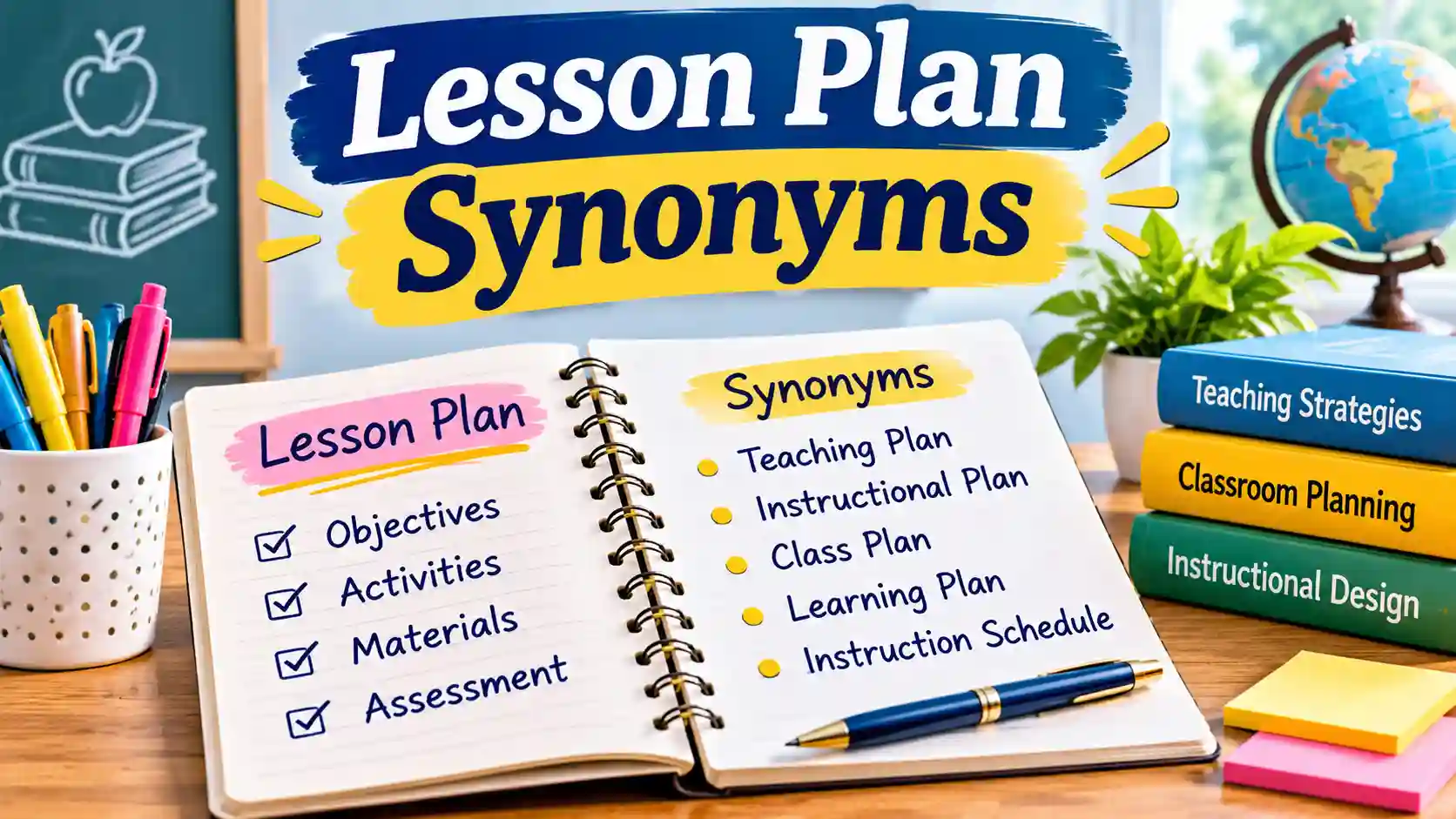
A clean, minimal landscape-oriented educational scene featuring an open teacher’s notebook, a neatly arranged weekly classroom schedule, lesson materials, and a chalkboard in a bright, welcoming classroom. Professional editorial photography, natural light, balanced composition, no text, logos, or watermark.
When teachers prepare for a class, they may call their document a lesson plan, teaching outline, or instructional guide. The best alternative depends on whether they mean a detailed teaching document, a sequence of activities, or a broader plan for learning.
For example, a short outline may list the lesson’s objectives and activities, while a unit plan may organize several related lessons. Choosing the right term makes educational writing clearer and more precise.
This guide explains useful alternatives to lesson plan, their differences, and how teachers, students, education bloggers, and academic writers can use them naturally.
What Does “Lesson Plan” Really Mean?
A lesson plan is a structured outline that explains what a teacher intends to teach during a lesson and how students will learn it. It commonly includes learning objectives, teaching activities, materials, timing, assessment methods, and expected outcomes.
The phrase is a noun and is widely used in schools, colleges, teacher-training programs, and educational settings. Depending on the document, a lesson plan may be brief and flexible or detailed enough to guide an entire class session.
Connotative Meaning of Lesson Plan
Connotation refers to the feelings or associations a word carries beyond its basic meaning.
- Positive: Teaching guide and instructional framework can suggest thoughtful preparation and organized learning.
- Neutral: Lesson outline and teaching plan are straightforward descriptions of planned instruction.
- Formal or technical: Instructional design and instructional blueprint can suggest a more systematic approach to organizing learning.
- Potentially misleading: Curriculum may sound relevant, but it usually refers to a broader program of learning rather than one lesson.
Most alternatives are neutral and professional. The main difference is their scope: some describe one class session, while others refer to a sequence of lessons or an entire course.
Etymology and Pronunciation
Lesson entered English through Old French and ultimately comes from Latin lectio, meaning “reading” or “a reading.” Plan came through French from Latin planum, associated with a level surface and later with a scheme or arrangement.
Pronunciation
- US English: lesson plan /ˈles.ən plæn/
- UK English: lesson plan /ˈles.ən plæn/
- Syllables: les-son plan (3 syllables)
Lesson Plan Synonyms — Grouped by Shade of Meaning
There is no perfect replacement for lesson plan in every situation. Some alternatives describe a document for one lesson, others emphasize the sequence of activities, and several refer to broader instructional planning.
1. Direct Alternatives for a Planned Lesson
These phrases are suitable when you need another way to describe a teacher’s written plan for a particular class session.
- Teaching plan — a plan for delivering instruction.
- Lesson outline — a brief structure of lesson content.
- Teaching outline — a summary of planned teaching points.
- Instructional plan — a structured plan for teaching.
- Lesson guide — a document guiding a class session.
- Teaching guide — guidance for delivering classroom instruction.
- Class plan — a plan for one class meeting.
- Instruction plan — an outline of planned instructional activities.
- Daily teaching plan — a plan for a day’s lessons.
- Classroom lesson guide — a practical guide for classroom teaching.
2. Alternatives Emphasizing Structure and Organization
These terms work when the main purpose is to show the order, timing, or arrangement of lesson components.
- Lesson framework — a structure for organizing a lesson.
- Teaching framework — a structure guiding instructional decisions.
- Instructional framework — an organized model for teaching.
- Lesson structure — the arrangement of lesson components.
- Lesson sequence — the order of activities or learning steps.
- Teaching sequence — the planned order of instruction.
- Activity sequence — the order of classroom tasks.
- Classroom schedule — the timing of classroom activities.
- Lesson timetable — the scheduled timing of lesson components.
- Teaching schedule — a timetable for planned instruction.
These terms overlap with lesson planning but are not all exact synonyms. A schedule emphasizes timing, while a framework emphasizes structure.
3. Alternatives Emphasizing Teaching Methods and Activities
Use these terms when the document focuses on how a teacher will present information, involve learners, and support understanding.
- Instructional guide — guidance for teaching a topic.
- Teaching procedure — the steps used to deliver instruction.
- Instructional sequence — the order of learning experiences.
- Activity plan — a plan for classroom tasks.
- Classroom activity plan — an outline of student activities.
- Teaching strategy plan — a plan for applying teaching strategies.
- Learning activity outline — a summary of planned learning tasks.
- Learning sequence — an ordered set of learning experiences.
- Lesson delivery plan — a plan for presenting a lesson.
- Instructional outline — a summary of instructional content.
4. Alternatives Emphasizing Objectives and Learning Outcomes
These expressions fit documents that connect classroom activities to what students should know or be able to do.
- Learning plan — a plan for achieving learning goals.
- Learning objectives plan — a plan organized around lesson objectives.
- Learning outcomes plan — a plan focused on expected results.
- Teaching and learning plan — a plan covering instruction and student learning.
- Learning experience plan — a plan for structured learning experiences.
- Assessment plan — a plan for checking student understanding.
- Learning design — the design of activities and learning experiences.
- Instructional design plan — a plan for designing instruction.
- Learning pathway — a route through learning stages or goals.
- Educational activity plan — a plan for learning-focused activities.
Some of these are related planning terms rather than direct substitutes. An assessment plan focuses on evaluating learning, while a lesson plan usually covers several parts of instruction.
5. Broader Planning Terms for Multiple Lessons
Choose these expressions when your document covers a series of lessons, a topic, or a longer teaching period rather than one class session.
- Unit plan — a plan for a group of related lessons.
- Teaching unit outline — a summary of a teaching unit.
- Course plan — a plan for a full course.
- Instructional program — an organized program of instruction.
- Curriculum plan — a plan for a broader educational program.
- Scheme of work — a sequence of teaching planned over time.
- Teaching roadmap — an overview of planned instructional stages.
- Course outline — a summary of course topics and structure.
- Module plan — a plan for a defined learning module.
- Instructional blueprint — a detailed design for planned instruction.
These broader terms should not replace lesson plan when you are specifically referring to a single class session.
Example Sentences Using Lesson Plan Alternatives
- The teacher prepared a teaching outline before introducing the new topic.
- Our lesson framework includes a warm-up, group discussion, and short assessment.
- The instructor revised the learning activity outline to give students more time for practice.
- The department created a unit plan covering four weeks of science lessons.
- The new scheme of work organizes the topics students will study throughout the term.
Lesson Plan Synonyms by Tone
The tone of an alternative affects how formal, practical, or technical your writing sounds.
- Neutral and everyday: teaching plan, lesson outline, class plan, lesson guide.
- Formal and professional: instructional plan, instructional framework, lesson delivery plan, instructional design plan.
- Practical and activity-focused: activity plan, classroom activity plan, teaching procedure, learning activity outline.
- Broad and curriculum-focused: unit plan, course plan, scheme of work, curriculum plan.
For school communication, lesson plan and teaching plan are usually clear choices. In academic or teacher-training documents, a more specialized term may be appropriate when it accurately describes the document.
Lesson Plan vs. Close Alternatives
Lesson Plan vs. Teaching Plan
A lesson plan usually focuses on one lesson or class session. A teaching plan can mean the same thing, but it may also describe a broader plan for delivering instruction across several sessions. Check the surrounding context to determine the intended scope.
Lesson Plan vs. Unit Plan
A lesson plan describes a single lesson, while a unit plan organizes several related lessons around a larger topic or learning goal. For example, a lesson plan might cover fractions on Monday, while a unit plan maps out the full fractions topic over several weeks.
Lesson Plan vs. Curriculum Plan
A lesson plan guides a particular class session. A curriculum plan addresses a broader educational program, including subject content, learning goals, and progression across a course or grade level. These terms should not be treated as interchangeable.
Lesson Plan vs. Scheme of Work
A lesson plan explains what will happen in a particular lesson. A scheme of work outlines what will be taught over a longer period, often showing the order of topics and lessons across a term or course. The phrase is especially common in British educational contexts.
How “Lesson Plan” Changes by Context
Daily Conversation
Teachers may naturally use lesson plan, teaching plan, or lesson outline when discussing classroom preparation. These familiar expressions are easy for colleagues and students to understand.
Writing and Blogging
In education articles, the best term depends on the content. Use lesson outline for a brief summary, activity plan for classroom tasks, and unit plan for a collection of connected lessons.
Internal link suggestion: [internal link: synonyms for education → synonyms-for-education]
Professional or Academic Writing
In teacher-training documents, curriculum discussions, or instructional design reports, terms such as instructional framework, learning design, and instructional plan may be more precise. Define specialized terms if readers may interpret them differently.
Creative or Informal Use
In informal teaching notes, class plan or teaching guide may sound more approachable. For a presentation or downloadable classroom resource, lesson guide can also be a useful label when the document offers practical guidance rather than a complete formal plan.
Internal link suggestion: [internal link: synonyms for organized → synonyms-for-organized]
Common Mistakes Learners Make
1. Using “Curriculum” for a Single Lesson
A curriculum normally covers a wider program of study, not one class session.
Correction: Use lesson plan for one lesson and curriculum plan for a broader educational program.
2. Treating “Schedule” as a Complete Synonym
A schedule shows when activities take place. It may not explain the teaching methods, objectives, or assessment steps.
Correction: Use classroom schedule when timing is central and lesson plan when you mean the full instructional outline.
3. Confusing a Lesson Plan with a Unit Plan
A unit plan covers several related lessons, while a lesson plan usually focuses on one.
Correction: Match the term to the scope of the document.
4. Using Technical Language Without a Reason
Terms such as instructional design plan may be appropriate in specialist writing but unnecessarily complicated in everyday communication.
Correction: Prefer familiar wording unless the technical term adds useful precision.
5. Assuming Every Alternative Means Exactly the Same Thing
An assessment plan focuses on checking learning, while a teaching procedure describes the steps of instruction. Neither necessarily covers everything in a complete lesson plan.
Correction: Identify the document’s main purpose before choosing a replacement term.
Frequently Asked Questions
What Is the Closest Synonym for Lesson Plan?
Teaching plan is one of the closest alternatives in everyday educational use. Lesson outline is also suitable when the document briefly summarizes the content and activities of a class.
What Is a Formal Word for Lesson Plan?
Instructional plan is a useful formal alternative. Instructional framework may be more appropriate when describing the structure or model that guides teaching rather than a specific written lesson document.
What Is a Shorter Term for Lesson Plan?
Lesson outline is a concise option when the document is brief. Class plan may also work in informal settings, although its meaning can be broader.
Is a Unit Plan the Same as a Lesson Plan?
No. A lesson plan usually covers one class session, while a unit plan organizes a series of related lessons around a larger topic or learning objective.
What Is Another Name for a Teaching Plan?
Depending on its purpose, alternatives include lesson plan, instructional plan, lesson outline, and teaching guide. Choose the term that accurately reflects the document’s scope and content.
Conclusion
The right alternative to lesson plan depends on what the document does. Teaching plan and lesson outline are close everyday alternatives, while unit plan, scheme of work, and curriculum plan refer to broader levels of educational planning.
Using precise terms helps teachers communicate clearly, prepare useful materials, and make educational writing easier to follow. It also helps students and readers understand whether a document describes one lesson, a sequence of activities, or a complete teaching program.
To explore the meaning and usage of the phrase, consult the lesson entry in Cambridge Dictionary. You can also read related articles on synonyms for education, synonyms for organized, and synonyms for important.

Evelyn Hartwell is a writer focused on making measurements, dimensions, and everyday units easier to understand. Her work explores practical questions about size, length, height, thickness, and unit conversions, with an emphasis on clear explanations and real-world examples. She writes for readers who want straightforward answers to everyday measurement questions without unnecessary technical language.