A minimalist landscape showing a diverse group of people near a town entrance, with subtle visual contrast between community belonging and barriers to entry. Neutral editorial style, respectful and non-stereotypical, no text.
The closest alternatives to nativism depend on context. Terms such as anti-immigrant sentiment, anti-immigrant prejudice, and xenophobia can describe hostility toward immigrants or outsiders. Nationalism and protectionism may overlap with nativism in some political arguments, but they have different meanings and are not exact synonyms.
Imagine reading an article about a political movement that argues newcomers threaten a country’s culture or jobs. Calling the position nativist communicates more than simple patriotism: it suggests preference for established or native-born residents over immigrants.
Choosing a precise alternative matters because words such as nationalism, xenophobia, and protectionism describe different beliefs and policies. This guide explains their distinctions for students, bloggers, content writers, and anyone who wants to discuss politics accurately.
What Does “Nativism” Really Mean?
Nativism is a political or social belief that favors people considered native to a country over immigrants or people viewed as outsiders. It often involves opposition to immigration and the belief that newcomers threaten local jobs, cultural traditions, national identity, or public resources.
Nativism is a noun commonly used in political science, history, sociology, and public debate. Its meaning depends on context, but in discussions of immigration, it usually carries a critical implication because it describes exclusionary preferences based on who is considered an established or native member of society.
The word has a separate meaning in some academic fields, where nativism can refer to the view that certain abilities or ideas are innate rather than learned. This article focuses on the political and social meaning.
Connotative Meaning of Nativism
Connotation refers to the emotional or cultural associations a word carries beyond its basic definition.
- Positive in the eyes of supporters: Some may frame nativist positions as protecting national identity, cultural continuity, or local workers.
- Neutral in academic description: Researchers may use nativism as an analytical term to classify political beliefs or movements.
- Negative in common political discussion: The word often suggests exclusion, anti-immigrant prejudice, or unfair preference for established residents.
The term is not interchangeable with patriotism. Loving one’s country does not necessarily mean opposing immigration or treating newcomers as less deserving of rights.
Etymology and Pronunciation
Nativism comes from native, ultimately derived from Latin nativus, meaning “born” or “innate.” The political meaning developed around the preference for people regarded as native to a place, particularly in opposition to immigration.
- US pronunciation: /ˈneɪ.tɪ.vɪ.zəm/
- UK pronunciation: /ˈneɪ.tɪ.vɪ.zəm/
- Syllables: na-tiv-ism (3 syllables)
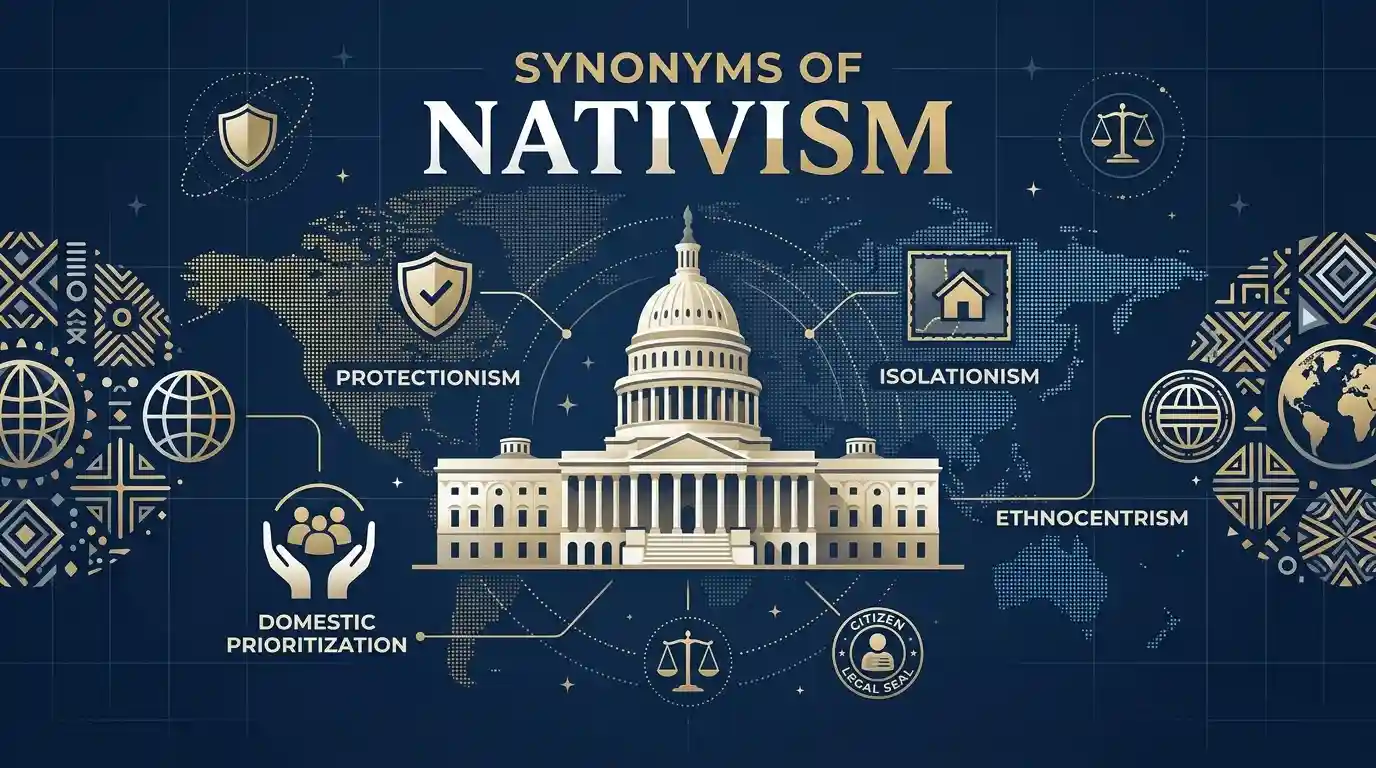
Synonyms of Nativism: Grouped by Shade of Meaning
There is no single set of perfect synonyms for political nativism. Some terms identify hostility toward immigrants, while others describe broader political ideologies or particular policies. The distinctions below help you select the most accurate expression.
1. Terms for Anti-Immigrant Attitudes
These are useful when nativism specifically involves opposition to immigration or negative assumptions about immigrants.
- Anti-immigrant sentiment — negative attitudes toward immigration or immigrants.
- Anti-immigrant prejudice — unfair judgments directed at immigrants.
- Anti-immigration sentiment — opposition to immigration as a policy or practice.
- Anti-immigrant hostility — open antagonism toward immigrant communities.
- Immigrant exclusion — keeping immigrants outside certain rights or opportunities.
- Anti-immigrant bias — a tendency to judge immigrants unfairly.
- Immigration restrictionism — support for limiting immigration.
- Exclusionary immigration politics — political approaches that restrict immigrant inclusion.
These expressions are especially appropriate when the issue is immigration itself. However, support for some immigration restrictions does not automatically prove nativism; the reasoning, language, and treatment of immigrants also matter.
2. Terms for Hostility Toward Outsiders
Use these alternatives when the central issue is fear, distrust, or prejudice toward people perceived as foreign or unfamiliar.
- Xenophobia — fear or dislike of foreigners or outsiders.
- Anti-foreigner sentiment — negative attitudes toward foreign people.
- Outsider hostility — antagonism toward people seen as outsiders.
- Foreignness-based prejudice — unfair treatment based on perceived foreign origin.
- Ethnic prejudice — negative judgments based on ethnic identity.
- Cultural intolerance — unwillingness to accept different cultural practices.
Xenophobia is one of the closest related terms, but it is broader than nativism. A person may express xenophobia without supporting a specific immigration policy, while nativism usually involves a political or social preference for established native populations over newcomers.
3. Terms Related to National Identity
These words may appear in discussions of nativism, but they describe different ideas about nationhood, identity, and belonging.
- Nationalism — strong identification with or support for one’s nation.
- Ethnonationalism — nationalism based on a shared ethnic identity.
- Cultural nationalism — emphasis on preserving a nation’s cultural identity.
- National exclusivism — limiting national belonging to selected groups.
- Identity-based exclusion — excluding people based on group identity.
- Majoritarianism — giving the majority group’s preferences dominant influence.
- Cultural chauvinism — belief that one’s culture is superior to others.
These terms should be used carefully. Nationalism can take inclusive or exclusionary forms, and cultural pride alone does not establish nativism. Ethnonationalism is more specific when national membership is tied to ethnic identity.
4. Terms Related to Economic Protection
Nativist arguments sometimes claim that immigrants threaten local workers or compete for limited resources. In such cases, economic terminology may help describe the argument.
- Economic protectionism — protecting domestic industries from outside competition.
- Labor-market protectionism — policies intended to protect local workers.
- Economic nationalism — prioritizing national economic interests.
- Employment protectionism — measures favoring domestic workers.
- Trade protectionism — limiting foreign competition in trade.
- Resource-based exclusion — restricting access based on claims about scarce resources.
These are related concepts, not direct synonyms. Protectionism usually concerns trade or economic policy. It becomes relevant to nativism only when economic arguments are linked to favoring native-born residents or excluding immigrants.
5. Terms for Exclusionary Political Beliefs
These expressions are useful when the emphasis is on unequal belonging, restrictive political ideas, or policies that disadvantage people considered outsiders.
- Exclusionism — a general tendency to exclude certain groups.
- Discriminatory nationalism — national preference expressed through unequal treatment.
- Anti-immigrant politics — political activity opposing immigration or immigrants.
- Restrictive immigration ideology — beliefs favoring strict limits on immigration.
- Social exclusion — preventing groups from full participation in society.
- Institutional discrimination — unequal treatment built into systems or institutions.
These terms differ in scope. Social exclusion can arise for many reasons unrelated to immigration, while institutional discrimination refers to patterns embedded in rules, practices, or organizations. Use them only when that broader or more specific meaning fits the evidence.
Example Sentences Using Related Terms
- The researcher examined how anti-immigrant sentiment influenced the election campaign.
- The report distinguished xenophobia from ordinary disagreement over immigration policy.
- The party’s ethnonationalism linked national identity to a particular ethnic background.
- The government introduced trade protectionism to support domestic industries, not specifically to restrict immigration.
- Critics argued that the proposal encouraged social exclusion by limiting newcomers’ access to essential services.
Synonyms of Nativism by Tone
Tone matters because these terms vary in scope and can carry different political implications.
| Tone or use | Suitable terms | When to use them |
|---|---|---|
| Academic or analytical | Nativism, xenophobia, ethnonationalism | Research and political analysis |
| Direct and descriptive | Anti-immigrant sentiment, anti-immigrant prejudice | Explaining attitudes toward immigrants |
| Policy-focused | Immigration restrictionism, restrictive immigration policy | Discussing proposed immigration limits |
| Economic | Economic nationalism, protectionism | Analyzing economic priorities |
| Broad social critique | Exclusionism, social exclusion, cultural intolerance | Discussing exclusionary behavior or systems |
Some alternatives are more emotionally charged than others. Anti-immigrant prejudice explicitly identifies bias, while immigration restrictionism describes a policy position without automatically claiming that its supporters are prejudiced.
Nativism vs. Close Alternatives
Nativism vs. Xenophobia
The term Nativism generally favors people considered native to a country over immigrants or outsiders. Xenophobia refers to fear, dislike, or hostility toward foreigners or people perceived as foreign.
A movement may display both, but the terms are not identical. Use nativism when discussing a preference for established native populations, and xenophobia when focusing on hostility toward foreigners.
Nativism vs. Nationalism
Nationalism centers on national identity, sovereignty, or the interests of a nation. Nativism adds a preference for people considered native over immigrants or newcomers.
A nationalist movement is not necessarily nativist. The term nativism is more accurate when the position involves exclusionary treatment of immigrants or a hierarchy between established residents and newcomers.
Nativism vs. Protectionism
Protectionism usually means protecting domestic industries or workers from external competition, especially through economic policies. Nativism is a broader social and political preference for native-born or established populations over immigrants.
The two can overlap when political arguments link immigration to jobs or economic resources. However, a trade tariff by itself is not evidence of nativism.
How Nativism-Related Terms Change by Context
Daily Conversation
In casual conversation, anti-immigrant attitudes may be clearer than nativism, especially when speaking with people unfamiliar with political terminology. If you mean fear or hostility toward foreigners generally, xenophobia may be more precise.
Writing and Blogging
Writers should identify the exact belief or behavior they are describing. Use anti-immigrant sentiment for public attitudes, immigration restrictionism for a policy position, and nativism when the preference for established native populations is central.
Related reading: [internal link: synonyms for prejudice → synonyms-for-prejudice]
Professional or Academic Writing
In academic work, define the term before applying it to a movement, policy, or historical period. Support the classification with relevant evidence rather than using nativism as a general insult for anyone who supports immigration limits.
Creative or Informal Writing
In opinion writing or commentary, more direct phrases such as anti-immigrant hostility can communicate a clear criticism. However, choose language that matches the evidence and distinguish between a person’s stated policy preference and hostility toward a group.
Related reading: [internal link: synonyms for nationalism → synonyms-for-nationalism]
Common Mistakes Learners Make
1. Treating Nationalism as an Exact Synonym
Nationalism can involve civic pride, independence, or national self-determination without hostility toward immigrants.
Correction: Use nativism when the preference for native or established residents over newcomers is central.
2. Calling Every Immigration Restriction Nativism
Governments may restrict immigration for different stated reasons, and the policy alone does not establish the broader ideology.
Correction: Examine the justification, intended effects, and whether the policy favors native populations by excluding or disadvantaging immigrants.
3. Confusing Xenophobia With Nativism
Xenophobia concerns fear or hostility toward foreigners. Nativism concerns a preference for native or established populations over immigrants.
Correction: Choose xenophobia for hostility toward perceived outsiders and nativism for the exclusionary political preference.
4. Using Protectionism to Describe Cultural Exclusion
Protectionism usually refers to economic policies, particularly trade barriers and domestic industry support.
Correction: Use cultural exclusion, anti-immigrant sentiment, or another more specific term when the issue is social or cultural rather than economic.
5. Using Strong Labels Without Evidence
Words such as xenophobia and ethnonationalism make specific claims about attitudes or ideology.
Correction: Describe the observable position first, then use a stronger label only when the available evidence supports it.
FAQs About Synonyms of Nativism
What is the closest synonym for nativism?
In immigration-related contexts, anti-immigrant sentiment is a useful close alternative. Xenophobia may fit when hostility toward foreigners is the main idea, but it does not capture every aspect of nativism.
What is a formal alternative to nativism?
Anti-immigrant sentiment, immigration restrictionism, and exclusionary immigration politics can work in formal writing, depending on the intended meaning. In academic work, nativism itself may be the most precise term when properly defined.
What is a simpler way to say nativism?
A clear alternative is favoring native-born residents over immigrants. This phrase explains the core political meaning without relying on specialized terminology.
Is nationalism the same as nativism?
No. Nationalism focuses on national identity and interests, while nativism specifically favors people considered native or established over immigrants or outsiders. Some nationalist movements are nativist, but the terms are not interchangeable.
What is the opposite of nativism?
There is no single exact opposite. Depending on the context, pro-immigration, inclusive nationalism, or multiculturalism may express contrasting positions, but each has its own meaning and should not automatically be treated as a direct antonym.
Conclusion
Understanding alternatives to nativism helps you discuss immigration, national identity, and political beliefs with greater accuracy. Terms such as xenophobia, anti-immigrant sentiment, nationalism, and protectionism overlap in some debates, but they describe distinct ideas.
When selecting a word, ask whether you mean hostility toward foreigners, preference for native-born residents, national identity, or economic restrictions. That distinction makes your writing more precise and helps readers understand the position being discussed.
To explore the term further, review the dictionary entry for nativism and compare related words before using them in an essay, article, or discussion.
Related reading: [internal link: synonyms for discrimination → synonyms-for-discrimination] · [internal link: synonyms for immigration → synonyms-for-immigration]

Evelyn Hartwell is a writer focused on making measurements, dimensions, and everyday units easier to understand. Her work explores practical questions about size, length, height, thickness, and unit conversions, with an emphasis on clear explanations and real-world examples. She writes for readers who want straightforward answers to everyday measurement questions without unnecessary technical language.