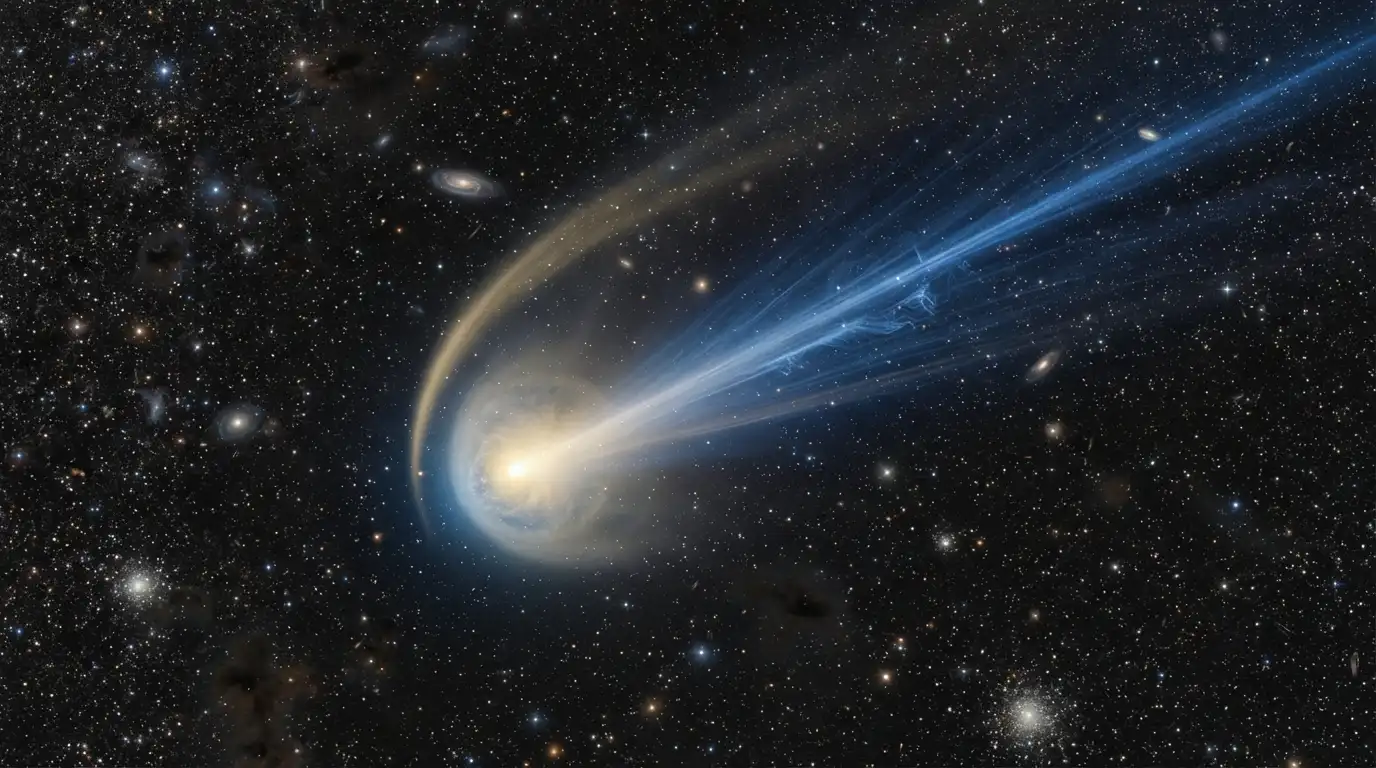
Synonyms for comet can help you describe a bright object in the night sky without repeating the same word. Imagine watching a comet leave a glowing trail.
A comet is an icy object that travels through space and can develop a bright coma and tail near the Sun. This makes synonyms for comet useful in writing.
For students, bloggers, and content writers, synonyms for comet add variety while keeping descriptions clear. Daily English users can also use related terms naturally.
Learning synonyms for comet also improves vocabulary because different words can highlight its icy nature, space setting, appearance, or scientific classification.
What Does “Synonyms for Comet” Really Mean?
The word comet is a noun. It refers to a small Solar System body made largely of ice, dust, and rocky material that orbits the Sun.
When a comet approaches the Sun, heat can cause material from its nucleus to escape. This can create a surrounding coma and, under suitable conditions, a visible tail.
In simple English, a comet is an icy space object that can appear as a bright point with a glowing tail when it gets close enough to the Sun.
Native speakers normally use comet when discussing astronomy, science, space exploration, or poetic descriptions of the night sky.
Importantly, English does not have 40–50 perfect one-word synonyms for comet. Terms such as celestial object, icy body, and minor body describe a comet in particular contexts but are broader scientific categories rather than exact synonyms.
That distinction matters. Good vocabulary writing should not present every related term as a perfect replacement.
Connotative Meaning
Connotation (the feeling or association a word can suggest beyond its basic dictionary meaning) varies with context.
Positive tone: A comet can suggest beauty, wonder, rarity, discovery, and mystery.
Negative tone: The word itself is generally neutral, although a comet may appear in discussions about possible impacts or space hazards.
Neutral tone: In astronomy, comet is a straightforward scientific term with no strong emotional meaning.
In literature, however, writers may use a comet as a symbol of sudden change, brilliance, speed, mystery, or something rare.
Etymology
The English word comet comes through Old French and Latin from Greek komētēs, meaning “long-haired,” referring to the object’s visible tail.
Old English: 450–1100
Comet was not an ordinary native Old English word. English speakers used other expressions for celestial phenomena, while the Greek-derived astronomical term entered English later.
Middle English: 1100–1500
The word entered Middle English through French and Latin influence. It referred to a celestial body with a visible tail.
Modern English: 1500–Present
Modern English retained comet as the standard astronomical term. Scientific knowledge later developed more precise terminology for comet nuclei, comae, tails, orbits, and related Solar System bodies.
Pronunciation
- US: /ˈkɑːmət/
- UK: /ˈkɒmɪt/
Syllables
com-et
Affixation Pattern of “Comet”
Root: From Greek komētēs, “long-haired”
Prefix: None
Suffix: No productive modern English suffix
The modern word is primarily a borrowed lexical root rather than a word formed through ordinary English affixation.
Synonyms List
Before exploring the list, remember that comet has very few exact synonyms. The terms below include close alternatives, scientific descriptors, and contextual expressions that can describe a comet without falsely claiming they are all interchangeable.
Icy Body (Noun) — US /ˈaɪsi ˈbɑːdi/ | UK /ˈaɪsi ˈbɒdi/
Meaning: An icy body is a space object containing substantial frozen material.
Examples:
- Scientists studied the icy body as it approached the Sun.
- The icy body released gas and dust.
Celestial Object (Noun) — US /səˈlɛstʃəl ˈɑːbdʒɛkt/ | UK /səˈlɛstʃəl ˈɒbdʒɪkt/
Meaning: A celestial object is any naturally occurring object in space.
Examples:
- The telescope detected a faint celestial object.
- The comet became the brightest celestial object in the image.
Celestial Body (Noun) — US /səˈlɛstʃəl ˈbɑːdi/ | UK /səˈlɛstʃəl ˈbɒdi/
Meaning: A celestial body is a naturally occurring physical object in space.
Examples:
- The comet is a fascinating celestial body.
- Astronomers tracked the celestial body for months.
Astronomical Object (Noun) — US /ˌæstrəˈnɑːmɪkəl ˈɑːbdʒɛkt/ | UK /ˌæstrəˈnɒmɪkəl ˈɒbdʒɪkt/
Meaning: An astronomical object is a natural object studied by astronomy.
Examples:
- The researchers cataloged the astronomical object.
- The object showed characteristics associated with a comet.
Space Object (Noun) — US /speɪs ˈɑːbdʒɛkt/ | UK /speɪs ˈɒbdʒɪkt/
Meaning: A space object is a naturally occurring object found beyond Earth.
Examples:
- The space object moved across the telescope’s field.
- Researchers calculated the space object’s orbit.
Solar System Body (Noun) — US /ˈsoʊlər ˈsɪstəm ˈbɑːdi/ | UK /ˈsəʊlə ˈsɪstəm ˈbɒdi/
Meaning: A Solar System body is a natural object that belongs to our planetary system.
Examples:
- The comet is a small Solar System body.
- Scientists mapped the Solar System body’s trajectory.
Minor Body (Noun) — US /ˈmaɪnər ˈbɑːdi/ | UK /ˈmaɪnə ˈbɒdi/
Meaning: A minor body is a relatively small natural body in the Solar System.
Examples:
- The astronomer recorded the minor body’s position.
- The comet belongs to the broader group of minor bodies.
Small Solar System Body (Noun) — US /smɔːl ˈsoʊlər ˈsɪstəm ˈbɑːdi/ | UK /smɔːl ˈsəʊlə ˈsɪstəm ˈbɒdi/
Meaning: This term describes a relatively small natural object orbiting the Sun.
Examples:
- The comet is classified as a small Solar System body.
- Researchers examined the body’s orbital path.
Icy Object (Noun) — US /ˈaɪsi ˈɑːbdʒɛkt/ | UK /ˈaɪsi ˈɒbdʒɪkt/
Meaning: An icy object is a space object containing frozen material.
Examples:
- The icy object moved toward the inner Solar System.
- The telescope captured the icy object at a great distance.
Icy Space Object (Noun) — US /ˈaɪsi speɪs ˈɑːbdʒɛkt/ | UK /ˈaɪsi speɪs ˈɒbdʒɪkt/
Meaning: An icy space object is a space body characterized by frozen material.
Examples:
- Scientists monitored the icy space object.
- The icy space object brightened near the Sun.
Frozen Body (Noun) — US /ˈfroʊzən ˈbɑːdi/ | UK /ˈfrəʊzən ˈbɒdi/
Meaning: A frozen body is a space body containing significant frozen substances.
Examples:
- The frozen body traveled on a long orbit.
- Heat changed the surface of the frozen body.
Frozen Space Body (Noun) — US /ˈfroʊzən speɪs ˈbɑːdi/ | UK /ˈfrəʊzən speɪs ˈbɒdi/
Meaning: A frozen space body is a natural space object containing ice.
Examples:
- The frozen space body passed through the inner Solar System.
- Researchers measured its activity.
Icy Solar System Object (Noun) — US /ˈaɪsi ˈsoʊlər ˈsɪstəm ˈɑːbdʒɛkt/ | UK /ˈaɪsi ˈsəʊlə ˈsɪstəm ˈɒbdʒɪkt/
Meaning: This phrase describes an icy natural object that orbits the Sun.
Examples:
- The icy Solar System object became easier to observe.
- Scientists calculated its orbit.
Cometary Body (Noun) — US /kəˈmiːtəri ˈbɑːdi/ | UK /kəˈmiːtəri ˈbɒdi/
Meaning: A cometary body is a body associated with cometary activity.
Examples:
- The probe approached the cometary body.
- Researchers analyzed material from the cometary body.
Cometary Object (Noun) — US /kəˈmiːtəri ˈɑːbdʒɛkt/ | UK /kəˈmiːtəri ˈɒbdʒɪkt/
Meaning: A cometary object is a space object showing or associated with comet-like characteristics.
Examples:
- Scientists identified the cometary object from its activity.
- The cometary object produced a faint coma.
Comet Nucleus (Noun) — US /ˈkɑːmət ˈnuːkliəs/ | UK /ˈkɒmɪt ˈnjuːkliəs/
Meaning: A comet nucleus is the solid central part of a comet.
Examples:
- The spacecraft photographed the comet nucleus.
- Dust covered much of the comet nucleus.
Dirty Snowball (Noun) — US /ˈdɝːti ˈsnoʊbɔːl/ | UK /ˈdɜːti ˈsnəʊbɔːl/
Meaning: Dirty snowball is an informal phrase describing a comet as a mixture of ice, dust, and rocky material.
Examples:
- The teacher called the comet a dirty snowball.
- The phrase helps children imagine its composition.
Icy Dusty Body (Noun) — US /ˈaɪsi ˈdʌsti ˈbɑːdi/ | UK /ˈaɪsi ˈdʌsti ˈbɒdi/
Meaning: An icy dusty body is a descriptive term for a space object containing ice and dust.
Examples:
- The icy dusty body became active near the Sun.
- Scientists observed dust leaving its surface.
Dusty Icy Object (Noun) — US /ˈdʌsti ˈaɪsi ˈɑːbdʒɛkt/ | UK /ˈdʌsti ˈaɪsi ˈɒbdʒɪkt/
Meaning: A dusty icy object is an object containing both frozen and dusty material.
Examples:
- The dusty icy object followed a long orbit.
- Its surface changed during the solar approach.
Ice-Rich Body (Noun) — US /ˈaɪs rɪtʃ ˈbɑːdi/ | UK /ˈaɪs rɪtʃ ˈbɒdi/
Meaning: An ice-rich body is a space body containing a large amount of frozen material.
Examples:
- Scientists studied the ice-rich body.
- The ice-rich body released gas near the Sun.
Ice-Rich Object (Noun) — US /ˈaɪs rɪtʃ ˈɑːbdʒɛkt/ | UK /ˈaɪs rɪtʃ ˈɒbdʒɪkt/
Meaning: An ice-rich object is a space object containing substantial ice.
Examples:
- The telescope detected the ice-rich object.
- The ice-rich object showed increasing activity.
Dust-and-Ice Body (Noun) — US /dʌst ænd aɪs ˈbɑːdi/ | UK /dʌst ənd aɪs ˈbɒdi/
Meaning: A dust-and-ice body is a descriptive phrase for an object containing dust and frozen material.
Examples:
- The comet resembles a dust-and-ice body.
- Scientists examined its changing surface.
Volatile-Rich Body (Noun) — US /ˈvɑːlətəl rɪtʃ ˈbɑːdi/ | UK /ˈvɒlətaɪl rɪtʃ ˈbɒdi/
Meaning: A volatile-rich body contains substances that can vaporize relatively easily.
Examples:
- The volatile-rich body became active near the Sun.
- Researchers measured gases from the object.
Active Comet (Noun) — US /ˈæktɪv ˈkɑːmət/ | UK /ˈæktɪv ˈkɒmɪt/
Meaning: An active comet is a comet currently producing visible activity such as a coma or tail.
Examples:
- The active comet brightened rapidly.
- Astronomers monitored the active comet.
Periodic Comet (Noun) — US /ˌpɪriˈɑːdɪk ˈkɑːmət/ | UK /ˌpɪəriˈɒdɪk ˈkɒmɪt/
Meaning: A periodic comet returns to the inner Solar System on a predictable orbital period.
Examples:
- The periodic comet returned as expected.
- Astronomers calculated its next passage.
Long-Period Comet (Noun) — US /ˌlɔːŋ ˈpɪriəd ˈkɑːmət/ | UK /ˌlɒŋ ˈpɪəriəd ˈkɒmɪt/
Meaning: A long-period comet has an orbital period of more than 200 years.
Examples:
- The long-period comet entered the inner Solar System.
- Researchers tracked its distant orbit.
Short-Period Comet (Noun) — US /ˌʃɔːrt ˈpɪriəd ˈkɑːmət/ | UK /ˌʃɔːt ˈpɪəriəd ˈkɒmɪt/
Meaning: A short-period comet completes its orbit around the Sun relatively quickly.
Examples:
- The short-period comet has a well-studied orbit.
- Scientists predicted its return.
Sungrazing Comet (Noun) — US /ˈsʌnˌɡreɪzɪŋ ˈkɑːmət/ | UK /ˈsʌnˌɡreɪzɪŋ ˈkɒmɪt/
Meaning: A sungrazing comet passes extremely close to the Sun.
Examples:
- The sungrazing comet approached the Sun.
- Scientists watched the comet during its passage.
Halley-Type Comet (Noun) — US /ˈhæli taɪp ˈkɑːmət/ | UK /ˈhæli taɪp ˈkɒmɪt/
Meaning: A Halley-type comet is a comet with an orbital period broadly similar to that of Halley’s Comet.
Examples:
- Researchers classified the object as a Halley-type comet.
- Its orbit attracted scientific interest.
Hyperbolic Comet (Noun) — US /ˌhaɪpərˈbɑːlɪk ˈkɑːmət/ | UK /ˌhaɪpəˈbɒlɪk ˈkɒmɪt/
Meaning: A hyperbolic comet follows an unbound or hyperbolic trajectory relative to the Sun.
Examples:
- The hyperbolic comet followed an unusual path.
- Astronomers calculated its trajectory.
Interstellar Comet (Noun) — US /ˌɪntərˈstɛlər ˈkɑːmət/ | UK /ˌɪntəˈstɛlə ˈkɒmɪt/
Meaning: An interstellar comet is a comet-like object that originated outside our Solar System.
Examples:
- Astronomers investigated the interstellar comet.
- The object’s trajectory suggested an outside origin.
Comet-Like Object (Noun) — US /ˈkɑːmət laɪk ˈɑːbdʒɛkt/ | UK /ˈkɒmɪt laɪk ˈɒbdʒɪkt/
Meaning: A comet-like object is an object that resembles a comet in appearance or activity.
Examples:
- The telescope revealed a comet-like object.
- Researchers examined its faint tail.
Tail-Bearing Celestial Body (Noun) — US /ˈteɪl ˈbɛrɪŋ səˈlɛstʃəl ˈbɑːdi/ | UK /ˈteɪl ˈbeərɪŋ səˈlɛstʃəl ˈbɒdi/
Meaning: A tail-bearing celestial body is a descriptive phrase for a space body that develops a visible tail.
Examples:
- The tail-bearing celestial body crossed the sky.
- The image showed a long tail.
Tailed Space Object (Noun) — US /teɪld speɪs ˈɑːbdʒɛkt/ | UK /teɪld speɪs ˈɒbdʒɪkt/
Meaning: A tailed space object is an informal descriptive term for an object displaying a tail.
Examples:
- The tailed space object appeared brighter overnight.
- The photograph captured its extended tail.
Sun-Approaching Icy Body (Noun) — US /ˈsʌn əˈproʊtʃɪŋ ˈaɪsi ˈbɑːdi/ | UK /ˈsʌn əˈprəʊtʃɪŋ ˈaɪsi ˈbɒdi/
Meaning: This phrase describes an icy body moving toward the Sun.
Examples:
- The Sun-approaching icy body became active.
- Scientists observed its changing appearance.
Cometary Nucleus (Noun) — US /kəˈmiːtəri ˈnuːkliəs/ | UK /kəˈmiːtəri ˈnjuːkliəs/
Meaning: A cometary nucleus is the solid nucleus at the center of a comet.
Examples:
- The spacecraft mapped the cometary nucleus.
- Researchers studied its irregular shape.
Cometary Visitor (Noun) — US /kəˈmiːtəri ˈvɪzɪtər/ | UK /kəˈmiːtəri ˈvɪzɪtə/
Meaning: A cometary visitor is a literary or journalistic phrase for a comet passing through a region of space.
Examples:
- The cometary visitor attracted public attention.
- Observers watched the visitor before dawn.
Cosmic Visitor (Noun) — US /ˈkɑːzmɪk ˈvɪzɪtər/ | UK /ˈkɒzmɪk ˈvɪzɪtə/
Meaning: A cosmic visitor is a broad informal expression for a space object that appears or passes through an area.
Examples:
- The cosmic visitor appeared in the evening sky.
- Newspapers described the comet as a cosmic visitor.
Space Wanderer (Noun) — US /speɪs ˈwɑːndərər/ | UK /speɪs ˈwɒndərə/
Meaning: A space wanderer is a poetic phrase for an object traveling through space.
Examples:
- The poet described the comet as a space wanderer.
- The space wanderer crossed the dark sky.
Cosmic Wanderer (Noun) — US /ˈkɑːzmɪk ˈwɑːndərər/ | UK /ˈkɒzmɪk ˈwɒndərə/
Meaning: A cosmic wanderer is a poetic description of a traveling celestial object.
Examples:
- The writer called the comet a cosmic wanderer.
- The cosmic wanderer inspired the story.
Night-Sky Visitor (Noun) — US /ˈnaɪt skaɪ ˈvɪzɪtər/ | UK /ˈnaɪt skaɪ ˈvɪzɪtə/
Meaning: A night-sky visitor is an informal phrase for a celestial object visible in the night sky.
Examples:
- The comet became a memorable night-sky visitor.
- Families gathered to watch the visitor.
Celestial Wanderer (Noun) — US /səˈlɛstʃəl ˈwɑːndərər/ | UK /səˈlɛstʃəl ˈwɒndərə/
Meaning: A celestial wanderer is a poetic term for a moving object in the sky.
Examples:
- The poem compares the comet to a celestial wanderer.
- The celestial wanderer symbolized change.
Cosmic Traveler (Noun) — US /ˈkɑːzmɪk ˈtrævələr/ | UK /ˈkɒzmɪk ˈtrævələ/
Meaning: A cosmic traveler is a figurative description of an object moving through space.
Examples:
- The story follows a cosmic traveler.
- The writer used the comet as a cosmic traveler.
Icy Traveler (Noun) — US /ˈaɪsi ˈtrævələr/ | UK /ˈaɪsi ˈtrævələ/
Meaning: An icy traveler is a poetic description of an icy space object moving through the Solar System.
Examples:
- The author described the comet as an icy traveler.
- The icy traveler returned after many years.
Sky Wanderer (Noun) — US /skaɪ ˈwɑːndərər/ | UK /skaɪ ˈwɒndərə/
Meaning: A sky wanderer is a poetic expression for an object moving across the sky.
Examples:
- The poem celebrates a mysterious sky wanderer.
- The comet became the story’s sky wanderer.
Tail-Bearing Object (Noun) — US /ˈteɪl ˈbɛrɪŋ ˈɑːbdʒɛkt/ | UK /ˈteɪl ˈbeərɪŋ ˈɒbdʒɪkt/
Meaning: A tail-bearing object is an object that displays a visible tail.
Examples:
- The telescope captured the tail-bearing object.
- Its tail stretched across the photograph.
Icy Visitor (Noun) — US /ˈaɪsi ˈvɪzɪtər/ | UK /ˈaɪsi ˈvɪzɪtə/
Meaning: An icy visitor is an informal or poetic phrase for a comet passing through the inner Solar System.
Examples:
- The icy visitor appeared before sunrise.
- Observers followed the icy visitor for several nights.
Frozen Traveler (Noun) — US /ˈfroʊzən ˈtrævələr/ | UK /ˈfrəʊzən ˈtrævələ/
Meaning: A frozen traveler is a figurative description of an icy object traveling through space.
Examples:
- The story presents the comet as a frozen traveler.
- The frozen traveler returns after a long journey.
Synonyms for “Comet” by Tone
Positive
Words such as cosmic visitor, celestial wanderer, cosmic traveler, and icy traveler can create a sense of wonder.
These expressions work especially well in creative writing, educational storytelling, and astronomy articles aimed at general readers.
Neutral
Scientific terms such as celestial object, astronomical object, Solar System body, icy body, and cometary body maintain an objective tone.
Use these when accuracy matters more than imagery.
Negative
Comet itself does not normally carry a negative connotation. However, terms such as potential impact object would introduce a danger-related idea rather than serve as a synonym.
Therefore, avoid calling such expressions synonyms unless the context specifically concerns hazards.
Playful / Informal
Dirty snowball, space wanderer, and night-sky visitor can sound more accessible or imaginative.
They suit casual explanations but may feel inappropriate in highly technical writing.
“Comet” vs Close Alternatives
Comet vs Icy Body
The term Comet is the specific astronomical term.
Icy body is broader and focuses on composition. Not every icy body should automatically be called a comet.
Use comet when you mean the specific type of Solar System object. Use icy body when discussing physical composition more generally.
Comet vs Celestial Object
Celestial object covers many kinds of natural objects in space, including stars, planets, moons, asteroids, and comets.
Therefore, it is a broader category rather than an exact synonym.
Comet vs Dirty Snowball
Dirty snowball is an informal explanatory expression.
It can help beginners visualize a comet’s mixture of ice, dust, and rocky material. However, it is not the preferred technical term.
How “Comet” Changes by Context
Daily Conversation
In everyday conversation, comet is usually enough.
You might say, “Did you see the comet last night?” This sounds natural and immediately identifies the subject.
Informal expressions such as space wanderer can work in conversation when you want a more playful tone.
Writing or Blogging
Bloggers can use comet, icy body, celestial object, and cosmic visitor to avoid repetitive descriptions.
However, context should guide the choice. A science article should prioritize accurate terminology, while a lifestyle or creative article can use more imagery.
Professional or Academic Tone
Scientific writing generally favors precise terms such as comet, comet nucleus, cometary body, and small Solar System body.
Avoid replacing comet with poetic expressions when technical accuracy matters.
Creative or Informal Use
Creative writers have greater freedom.
Expressions such as celestial wanderer, cosmic traveler, and icy visitor can make descriptions more vivid.
These terms create imagery rather than providing exact scientific classification.
Common Mistakes & Native Usage
Treating Every Related Term as an Exact Synonym
A celestial object can be a comet, but it can also be a star or planet.
Likewise, an icy body can describe objects other than comets. These terms are contextual alternatives, not perfect replacements.
Calling a Comet an Asteroid
A comet and an asteroid are different categories of Solar System objects.
Some objects can show characteristics that blur traditional categories, but writers should not casually use asteroid as a synonym for comet.
Using “Tail” as a Synonym
A tail is a feature that a comet can develop. It is not another word for the entire comet.
The same applies to coma and nucleus. They describe parts or features of a comet.
Using “Dirty Snowball” in Formal Science Writing
The phrase can help beginners understand comet composition, but it has an informal tone.
Use comet or a precise scientific description in academic writing.
Overusing Poetic Alternatives
Words such as cosmic traveler can make creative writing attractive, but repeated figurative descriptions can sound unnatural.
Use them occasionally and return to comet when clarity matters.
Register Notes
Formal: comet, comet nucleus, cometary body, small Solar System body
Neutral: celestial object, icy body, space object
Informal: dirty snowball, space wanderer, icy visitor
Poetic: celestial wanderer, cosmic traveler, sky wanderer
In spoken English, simple words such as comet and space object feel natural.
In academic writing, precise scientific terminology usually works better than poetic alternatives.
Real-Life Examples Using “Comet”
Workplace
A science writer may describe a newly observed comet in a research-based article.
Instead of repeating comet in every sentence, the writer can occasionally use icy body or celestial object, provided the meaning remains clear.
Social Situations
Imagine friends standing outside after sunset.
One person might say, “That comet is brighter than I expected.” Another might casually call it a “cosmic visitor.”
The first sounds ordinary. The second sounds more expressive.
Media and Pop Culture
News stories often use phrases such as cosmic visitor to make astronomy easier for general audiences.
Such language creates interest without replacing the scientific name throughout the article.
Writing and Storytelling
A novelist might describe a comet as a celestial wanderer crossing the darkness.
This gives the scene a poetic feeling. The scientific word comet can then appear when the story needs clarity.
Conclusion
Understanding synonyms for comet helps you choose words that match your audience, whether you are writing a science lesson, blog post, story, or everyday conversation.
The most useful approach is not to replace comet every time. Use exact terminology for accuracy and related expressions when they add useful detail.
Words such as icy body, celestial object, and cometary body suit informative writing, while cosmic traveler and celestial wanderer create a more imaginative tone.
Practice these alternatives in essays, emails, articles, and conversations. The more naturally you use them, the stronger and more flexible your vocabulary becomes.
Practice Exercises: Synonyms for Comet
Test your understanding of words and expressions related to comet with these short exercises.
1. Pick the Closest Meaning
Choose the option that best describes the word comet.
- A natural object that travels through space
- A. Celestial object
- B. Building
- C. Landform
- D. Vehicle
- An object commonly associated with ice, dust, and a visible tail
- A. Planet
- B. Comet
- C. Galaxy
- D. Moon
- Which phrase can be used as a broad description of a comet?
- A. Cosmic object
- B. Oceanic feature
- C. Terrestrial structure
- D. Weather system
2. Identify the Best Alternative
Replace comet with the most appropriate alternative in each sentence.
- Astronomers observed a bright comet moving across the sky.
- The comet became easier to see as it approached the Sun.
- Scientists studied the newly discovered comet using a powerful telescope.
- The ancient observers recorded the appearance of a comet.
Write your answers using suitable terms such as celestial body, cosmic object, icy body, astronomical object, or another contextually appropriate expression.
3. Which One Fits?
Select the word or phrase that makes the sentence most natural.
- The telescope detected a distant ________ traveling through space.
- comet
- ocean
- mountain
- Scientists described the object as an ________ containing ice and dust.
- icy body
- ecosystem
- landmass
- The bright ________ attracted the attention of astronomers.
- celestial body
- building
- plant
4. Related or Not Related?
Decide whether each word is closely related to a comet or not closely related.
- Celestial body — __________
- Cosmic object — __________
- Icy body — __________
- Planet — __________
- Astronomical object — __________
- Ocean — __________
- Space object — __________
- Galaxy — __________
5. Improve the Sentence
Replace the repeated word comet with a suitable descriptive expression.
Example:
The comet was visible through the telescope.
→ The celestial body was visible through the telescope.
Now try these:
- The comet entered the inner solar system.
- Researchers photographed the comet from an observatory.
- The comet contained ice, dust, and rocky material.
- The comet developed a bright tail near the Sun.
6. Meaning Match
Connect each expression with the idea it conveys.
Expressions
A. Celestial body
B. Cosmic object
C. Icy body
D. Astronomical object
Meanings
- A general term for an object studied in astronomy
- A space object described in broad terms
- A natural object in space
- A space body characterized by a significant amount of ice
Answers:
A — ___
B — ___
C — ___
D — ___
7. Spot the Incorrect Substitute
Each sentence contains a word used as a possible substitute for comet. Identify the one that does not work.
- The celestial body appeared in the night sky.
- The cosmic object was observed by astronomers.
- The planet developed a long tail as it approached the Sun.
- The icy body moved through the solar system.
Which sentence contains the incorrect substitute? ________
8. Context Switch
Choose the expression that sounds most natural for each situation.
A. Scientific writing
Scientists analyzed the newly discovered ________.
- celestial body
- thing
- object in the sky
B. General writing
A bright ________ appeared over the horizon.
- comet
- astronomical entity
- extraterrestrial body
C. Descriptive writing
The mysterious ________ crossed the dark night sky.
- cosmic object
- icy body
- comet
9. Rewrite Without Repetition
Read the short paragraph:
A comet appeared in the night sky. The comet became brighter as it moved closer to the Sun. Scientists then studied the comet with a telescope.
Rewrite the paragraph so that comet is not repeated unnecessarily. Use suitable alternatives or descriptive phrases.
10. Your Turn
Write a short paragraph of 3–4 sentences about a comet.
Try to use at least three different expressions related to the word, such as:
- celestial body
- cosmic object
- icy body
- astronomical object
- space object
Make sure each expression fits naturally rather than forcing a synonym where it does not belong.

Evelyn Hartwell is a writer focused on making measurements, dimensions, and everyday units easier to understand. Her work explores practical questions about size, length, height, thickness, and unit conversions, with an emphasis on clear explanations and real-world examples. She writes for readers who want straightforward answers to everyday measurement questions without unnecessary technical language.