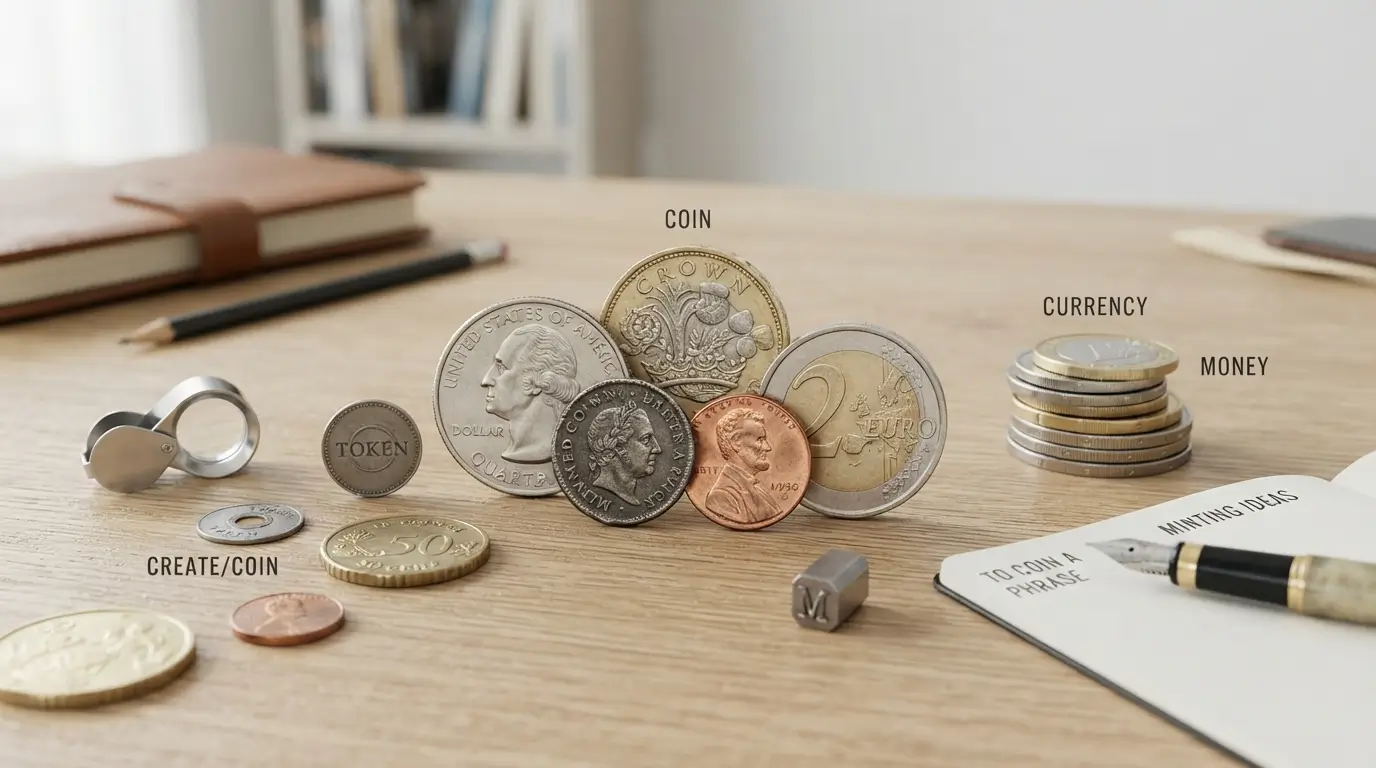
Synonyms for coin can help you choose the right word when writing about money, currency, or a newly created word or phrase in English.
When you hear synonyms for coin, you might think of words such as change, cash, token, or specie. The best choice depends on context.
The word coin is commonly used because it can describe physical money and also the act of creating a new expression, making its alternatives useful in many situations.
Learning synonyms for coin can improve vocabulary for students, bloggers, content writers, and anyone who wants more natural daily English.
Quick Answer: What Are the Synonyms for Coin?
The closest alternatives to coin depend on which meaning you intend.
For physical money, useful alternatives include:
- Change
- Cash
- Specie
- Token
- Counter
- Piece of money
- Coinage
- Round
- Money
- Currency
For the verb coin, meaning “to create a new word or phrase,” alternatives include:
- Create
- Invent
- Devise
- Formulate
- Introduce
- Develop
- Name
- Craft
- Fashion
- Generate
Some words are context-specific alternatives rather than exact synonyms. For example, currency refers to money generally, while denomination refers to the stated value of a coin or banknote.
What Does Coin Mean?
Coin is primarily a noun referring to a small, usually round piece of metal issued as money.
For example:
She found a coin under the sofa.
As a verb, coin means to create or introduce a new word, phrase, or expression.
For example:
The journalist coined a phrase that quickly became popular.
This gives the word coin two important meanings:
- A physical form of money
- The creation of a new word or expression
Because these meanings are different, the best synonym changes with the sentence.
Coin: Meaning, Connotation, and Usage
As a noun, coin is usually neutral. It simply identifies physical money made from metal.
Words such as change and cash are common in everyday English, although they are not always exact replacements.
Specie is more formal and historical. It generally refers to money in the form of coins rather than paper money.
As a verb, coin is also neutral. It is frequently used when discussing language, terminology, slogans, expressions, or newly introduced phrases.
Coin Pronunciation and Word Structure
US IPA: /kɔɪn/
UK IPA: /kɔɪn/
Syllables: 1
Part of speech: noun and verb
The word coin does not contain a common English prefix or suffix. It is a simple lexical root.
Its history is particularly interesting because the modern English word is connected to the physical process of making money.
Etymology of Coin
The noun coin entered English through Anglo-Norman and Old French forms such as coin and coigne. These words were associated with a wedge, corner, or die used in making impressions.
The deeper origin is connected to the Latin word cuneus, meaning “wedge.”
During Middle English, forms such as coin, coyn, and coigne appeared.
Over time, the word became strongly associated with minted money.
The verb later developed the meaning “to make coins.” From there, its figurative use expanded to mean creating a new word or phrase.
That is why English speakers can say that someone coined a term.
Synonyms List
Change — Noun
Meaning: Money in the form of coins, especially small-value coins received after paying for something.
Examples:
- I found some change in my pocket.
- She needed change for the parking machine.
Cash — Noun
Meaning: Money that exists as physical currency, although the word can also include banknotes.
Examples:
- He paid for the coffee in cash.
- I usually carry a little cash with me.
Specie — Noun
Meaning: Money in the form of coins rather than paper currency.
Examples:
- The payment was made in specie.
- The museum displays examples of gold specie.
Token — Noun
Meaning: A small object used instead of money for a particular purpose.
Examples:
- The arcade uses a token system.
- She received a bus token from the attendant.
Counter — Noun
Meaning: A token or piece used as a substitute for money or as a marker in a game or system.
Examples:
- The old game used metal counters.
- Each player received several counters.
Piece of Money — Noun Phrase
Meaning: A general expression for an individual unit of physical money.
Examples:
- He discovered an old piece of money.
- The child picked up a piece of money from the ground.
Coinage — Noun
Meaning: Coins collectively, or the system of coins produced by a government or authority.
Examples:
- The museum has an impressive collection of Roman coinage.
- Ancient coinage can reveal information about a civilization.
Round — Noun
Meaning: An informal or specialized term for a round coin or coin-like object.
Examples:
- The collector examined the silver round.
- The dealer showed him a commemorative round.
Money — Noun
Meaning: A general medium of exchange used to buy goods and services.
Examples:
- She kept the money in a small wallet.
- The child counted the money carefully.
Usage note: Money is broader than coin because it can include coins, banknotes, and money held electronically.
Currency — Noun
Meaning: A country’s officially recognized monetary system or the money used within it.
Examples:
- The local currency includes several coins.
- Travelers exchanged their currency at the airport.
Usage note: Currency is a broader term, not an exact synonym for one coin.
Denomination — Noun
Meaning: The stated monetary value of a coin or banknote.
Examples:
- The machine accepts several denominations.
- This coin has a low denomination.
Usage note: A denomination is the value assigned to money, not the physical coin itself.
Disc — Noun
Meaning: A flat, round object; sometimes used for a coin-shaped object.
Examples:
- The artifact looks like a small metal disc.
- The machine detected a metal disc.
Usage note: Disc describes shape rather than monetary function.
Medal — Noun
Meaning: A metal object awarded for achievement, usually not used as ordinary money.
Examples:
- She received a gold medal.
- The medal has a detailed design.
Usage note: A medal is not a true synonym for a coin. It is included only as a related coin-shaped object.
Medallion — Noun
Meaning: A large decorative or commemorative metal piece, often resembling a coin.
Examples:
- The museum displayed a bronze medallion.
- He wore a small medallion around his neck.
Penny — Noun
Meaning: A coin with a very small monetary value, especially in British or US contexts depending on the specific currency system.
Examples:
- She found a penny on the sidewalk.
- He dropped a penny into the jar.
Cent — Noun
Meaning: A monetary unit equal to one hundredth of certain currencies, including the US dollar.
Examples:
- The price was reduced by one cent.
- He found a cent near the door.
Nickel — Noun
Meaning: A US five-cent coin.
Examples:
- He put a nickel in the vending machine.
- She found a nickel beside the chair.
Dime — Noun
Meaning: A US coin worth ten cents.
Examples:
- I found a dime in my pocket.
- The child saved every dime.
Quarter — Noun
Meaning: A US coin worth twenty-five cents.
Examples:
- She inserted a quarter into the machine.
- He collected an unusual quarter.
Farthing — Noun
Meaning: A former British coin worth one quarter of an old penny.
Examples:
- The collector owns an old farthing.
- The book describes the history of the farthing.
Groat — Noun
Meaning: An old British silver coin historically valued at four pence.
Examples:
- The exhibit contains a medieval groat.
- He read about the old groat in a history book.
Florin — Noun
Meaning: A historical coin used in Britain and other countries, with different values depending on the monetary system.
Examples:
- The collector found a Victorian florin.
- The museum displayed an old florin.
Ducat — Noun
Meaning: A historical European gold or silver coin used in various countries.
Examples:
- The treasure included a gold ducat.
- The historian studied a Venetian ducat.
Sovereign — Noun
Meaning: A British gold coin traditionally worth one pound sterling.
Examples:
- The collector purchased an old sovereign.
- The museum displays a gold sovereign.
Crown — Noun
Meaning: A former British coin associated with a value of five shillings.
Examples:
- The collection includes a silver crown.
- He learned about the old British crown.
Shilling — Noun
Meaning: A former British monetary unit and coin.
Examples:
- The novel mentions an old shilling.
- He discovered a Victorian shilling.
Synonyms for Coin as a Verb
Create — Verb
Meaning: To bring something new into existence.
Examples:
- The writer created a new expression.
- The campaign created a memorable phrase.
Invent — Verb
Meaning: To create something new that did not previously exist.
Examples:
- She invented a playful expression.
- The author invented a new term for the concept.
Devise — Verb
Meaning: To develop or think of a new idea, method, or expression.
Examples:
- The researchers devised a useful term.
- He devised a phrase for the new process.
Formulate — Verb
Meaning: To develop something carefully and systematically.
Examples:
- The team formulated a new definition.
- The researcher formulated a term for the concept.
Introduce — Verb
Meaning: To bring a new word, idea, or expression into use.
Examples:
- The author introduced a new term.
- The article introduced an unusual expression.
Develop — Verb
Meaning: To create or gradually establish something.
Examples:
- The group developed a new phrase.
- Researchers developed terminology for the field.
Name — Verb
Meaning: To give something a particular name.
Examples:
- Scientists named the newly identified process.
- The writer named the concept clearly.
Craft — Verb
Meaning: To create something carefully and deliberately.
Examples:
- The writer crafted a memorable expression.
- She crafted a concise term for the idea.
Fashion — Verb
Meaning: To make or shape something into a particular form.
Examples:
- The author fashioned a new expression.
- He fashioned the phrase from existing words.
Generate — Verb
Meaning: To produce or create something.
Examples:
- The discussion generated a new phrase.
- The writer generated several possible terms.
Construct — Verb
Meaning: To build or form something from separate parts.
Examples:
- The researcher constructed a useful term.
- The writer constructed the phrase from familiar words.
Form — Verb
Meaning: To create or bring something into a particular shape or structure.
Examples:
- The community formed a new expression.
- The writer formed the term from two words.
Build — Verb
Meaning: To develop something gradually from existing parts or ideas.
Examples:
- The writer built a new phrase around the concept.
- The team built terminology for the project.
Concoct — Verb
Meaning: To create something by combining different elements, often in an inventive way.
Examples:
- He concocted a funny expression.
- The writer concocted an unusual name.
Come Up With — Verb Phrase
Meaning: To think of or create an idea, name, or expression.
Examples:
- She came up with a clever phrase.
- The team came up with a new name.
Think Up — Verb Phrase
Meaning: To invent or devise an idea or expression.
Examples:
- He thought up a memorable slogan.
- They thought up a new term.
Dream Up — Verb Phrase
Meaning: To imagine and create an unusual idea, name, or expression.
Examples:
- The writer dreamed up a playful phrase.
- They dreamed up an unusual name for the project.
Popularize — Verb
Meaning: To make a word, expression, or idea widely known or used.
Examples:
- The author popularized the expression.
- The television show popularized the phrase.
Usage note: Popularize is related to coin, but it does not mean exactly the same thing.
Mint — Verb
Meaning: To produce coins; figuratively, to create something new, especially a term or phrase.
Examples:
- The government minted new coins.
- The writer minted a memorable expression.
Positive, Neutral, Negative, and Informal Alternatives
The synonyms for coin do not naturally divide into positive and negative groups in the same way that descriptive adjectives do.
Instead, they are better organized by meaning and register.
Neutral and Everyday
- Change
- Cash
- Money
- Coinage
- Coin
- Currency
Formal or Historical
- Specie
- Ducat
- Florin
- Sovereign
- Groat
- Farthing
- Shilling
Informal or Conversational
- Cash
- Change
- Piece of money
- Come up with
- Think up
Creative or Language-Related
- Create
- Invent
- Devise
- Craft
- Formulate
- Name
- Fashion
- Mint
Coin vs. Change vs. Cash
These words are often confused because they can all relate to physical money.
| Word | Main Meaning | Exact Synonym for Coin? |
|---|---|---|
| Coin | Physical metal money | Yes |
| Change | Small coins or money returned after payment | Sometimes |
| Cash | Physical money, including notes and coins | No, broader |
| Currency | A monetary system or money in circulation | No, broader |
| Specie | Money specifically in coin form | Close, formal |
For example, you can say:
I have some coins in my pocket.
You could also say:
I have some change in my pocket.
But cash could mean both coins and banknotes.
Coin vs. Currency
Coin refers to a physical piece of money.
Currency is a broader concept. It can refer to the monetary system of a country or the money currently circulating.
For example:
The US dollar is a currency.
But:
This quarter is a coin.
Therefore, currency should not normally replace coin when you are specifically talking about a physical metal piece.
Coin vs. Token
A coin is normally issued as official money.
A token may look like a coin but is usually created for a specific purpose.
For example, an arcade token can be exchanged for game credits inside an arcade.
So, although the two objects may look similar, they are not exact synonyms.
Using Coin in Different Contexts
Daily Conversation
In everyday English, coin, change, and cash are the most useful terms.
Do you have any coins for the machine?
I need some change.
These sound natural in ordinary conversation.
Academic and Historical Writing
Historical terms such as specie, ducat, florin, sovereign, and shilling may appear when discussing older monetary systems.
The exact term should match the historical period.
Professional Writing
Financial or technical writing may use coinage, denomination, currency, and specie depending on the subject.
Accuracy matters because these words describe different aspects of money.
Creative and Informal Writing
When coin is used as a verb, words such as invent, create, craft, and come up with can work depending on the sentence.
For example:
The author coined the term.
A less formal version could be:
The author came up with the term.
Common Mistakes When Choosing Synonyms for Coin
Treating Currency as an Exact Synonym
Currency is broader than coin. It can include coins, banknotes, and other forms of money.
Using Medal to Mean Coin
A medal may look like a coin, but it is generally awarded or commemorative rather than ordinary money.
Confusing Denomination with Coin
A denomination describes monetary value. It is not the physical object itself.
Using Historical Coin Names Incorrectly
Words such as ducat, groat, and shilling refer to specific historical coins or monetary units.
They should not be used as generic replacements for every coin.
Confusing Coin as a Noun and Verb
The noun refers to physical money.
The verb can mean creating a new word or expression.
The sentence determines which meaning applies.
Real-Life Examples of Coin Synonyms
At a Store
Someone pays with a banknote and receives coins back.
The natural word is change.
At an Arcade
A customer receives special metal pieces to use in games.
The appropriate word is tokens, not ordinary coins.
In a History Class
A teacher discusses money used in medieval Britain.
Words such as groat, farthing, or shilling may be appropriate depending on the period.
In Language Writing
A journalist creates a new expression that becomes popular.
The natural verb is coin.
For example:
The journalist coined a memorable phrase.
How to Choose the Right Synonym for Coin
Ask yourself what you mean before replacing the word.
If you mean physical money, consider coin, change, or specie.
If you mean money generally, cash or currency may be more suitable.
When you mean a special coin-like object, token or medallion could fit.
If you mean creating a new expression, use invent, create, devise, craft, or come up with.
This simple distinction prevents most synonym mistakes.
FAQs
What is the closest synonym for coin?
For the physical-money meaning, specie can be a close formal alternative, while change is common in everyday situations. However, neither replaces coin perfectly in every sentence.
What is another word for coin in everyday English?
Change is one of the most natural everyday alternatives when referring to coins collectively or small amounts of money. Cash is also common, but it can include banknotes.
What is a synonym for coin as a verb?
When coin means creating a new word or phrase, alternatives include create, invent, devise, formulate, craft, name, and come up with.
Is cash a synonym for coin?
Cash is related to coin but is not an exact synonym. Cash can include both coins and banknotes, while a coin specifically refers to a physical piece of money.
Is currency another word for coin?
Not exactly. Currency is a broader term that can refer to a country’s monetary system or the money in circulation. Coins can be one form of currency.
What is a formal synonym for coin?
Specie is a formal term for money in the form of coins. Coinage is another useful formal term when referring to coins collectively or a system of minted coins.
What does coined mean in writing?
In writing, coined usually means that someone created or introduced a new word, phrase, or expression. For example, an author may have coined a new term for a recently observed idea.
Practice Exercise
Choose the Best Alternative
- I found some ___ under the sofa.
A. currency
B. change
C. denomination
D. specie - The arcade gives players special ___.
A. tokens
B. currencies
C. denominations
D. cash - The writer ___ a new expression for the trend.
A. minted
B. coined
C. invented
D. All of these can work in the right context - A US five-cent coin is called a ___.
A. dime
B. nickel
C. quarter
D. cent - The historian studied ancient gold ___.
A. specie
B. change
C. cash
D. counters - The author ___ a memorable phrase.
A. devised
B. denomination
C. currency
D. coinage - A coin’s stated monetary value is its ___.
A. token
B. denomination
C. counter
D. specie - The museum displayed an old British ___.
A. groat
B. cash
C. change
D. currency - She ___ a clever name for the project.
A. came up with
B. coinage
C. specie
D. denomination - Which word can refer to money in both coins and banknotes?
A. cash
B. penny
C. token
D. groat
Answer Key: 1-B | 2-A | 3-D | 4-B | 5-A | 6-A | 7-B | 8-A | 9-A | 10-A
Reflection and Application
Write three short sentences using coin, change, and coined. Make each sentence show a different meaning or context.
Conclusion
Synonyms for coin become easier to understand when you first identify whether you mean physical money or creating a new expression.
Words such as change, cash, and specie can describe money, while invent, devise, and craft can replace the verb coin in suitable contexts.
The key is choosing a word that matches the exact meaning, tone, and situation. This makes your English more natural and precise.
Practice these alternatives in emails, essays, conversations, and creative writing. The more you use them in context, the easier vocabulary becomes.

Evelyn Hartwell is a writer focused on making measurements, dimensions, and everyday units easier to understand. Her work explores practical questions about size, length, height, thickness, and unit conversions, with an emphasis on clear explanations and real-world examples. She writes for readers who want straightforward answers to everyday measurement questions without unnecessary technical language.